
Quick answer
The best card draw upgrade fits what a precon already does and works on the turns when its hand runs low. Compare reliable burst draw with engines that need creatures, tokens, deaths, or artifacts. Human tokens favor different triggers from Zombie sacrifices or Vehicle setup. Keep the stock draw that still performs a useful job, and name both the cut and the resources the new card requires.
Identify why the hand runs out
Running out of cards can mean several things. The deck may have no affordable draw spell after a wipe, an engine that needs a board you cannot maintain, or expensive draw that stays stranded in hand. Those problems need different replacements. Record the turn and the resources available when the hand stalled. A card that draws five from a large board does little for the position where you have only lands and an empty battlefield.
Separate burst draw from continuing engines. A spell such as Night’s Whisper gives cards now and then leaves the stack. An enchantment that draws from creature entries can reward several later turns but may do nothing until another card supplies the event. A balanced package can use both patterns. Do not remove the last independent draw spell simply because a conditional engine has a higher maximum output.
Use the exact stock list from the precon finder and your actual list in the deck builder. Many precons already include useful draw cards. An upgrade guide should help you replace a weak fit, not persuade you to buy a second ordinary copy of a card already present. Keep an original version so you can compare the function you gained with the function you removed.
Read the trigger before choosing an engine
| Card | Event that matters | Important limit |
|---|---|---|
| Tocasia’s Welcome | A creature you control with mana value 3 or less enters | Only once each turn |
| Welcoming Vampire | Another creature you control with power 2 or less enters | Only once each turn; entry power includes applicable bonuses |
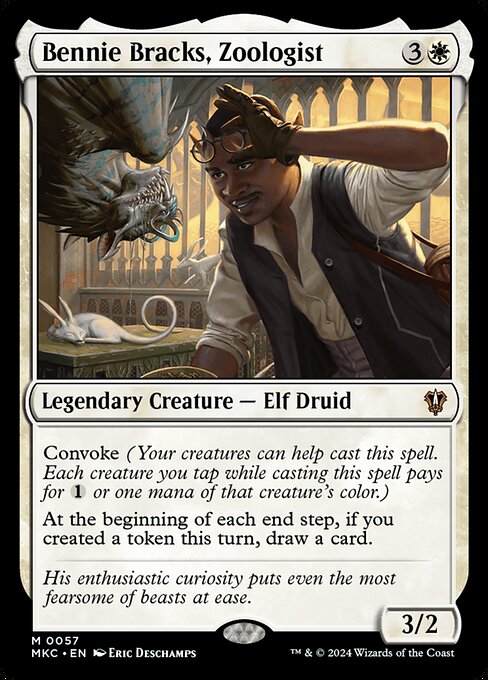
| Bennie Bracks, Zoologist | Beginning of an end step after you created a token that turn | The token must have been created during that particular turn |
| Idol of Oblivion | Its tap ability, after you created a token that turn | Needs an available tap and a new token event that turn |
| Morbid Opportunist | One or more other creatures die | Only once each turn, including deaths of opposing creatures |
| Vanquisher’s Banner | You cast a creature spell of the chosen type | Putting a creature directly onto the battlefield is not casting it |
These distinctions change real upgrade choices. A Human token produced by Éowyn enters but was not cast. A Zombie returned directly by reanimation enters but was not cast either. A creature token dying is a death event even though the token subsequently ceases to exist. Choose an engine whose condition follows the actions the deck actually takes, and check whether a once-per-turn limit prevents the large draw you imagined.
Do not confuse a per-turn limit with a per-round limit. An engine that triggers once each turn can sometimes draw on several players’ turns, but only when a qualifying event occurs on each of those turns. Making tokens on your own turn does not automatically satisfy a condition on the next opponent’s turn. The deck needs appropriate timing permissions and an actual way to produce the event.
Riders of Rohan: entries can matter more than creature casts
Stock Riders of Rohan includes Vanquisher’s Banner, a five-mana artifact that buffs the chosen creature type and draws when you cast a creature spell of that type. Tocasia’s Welcome is absent from the stock list and is a possible alternative when the deck increasingly relies on small creature entries and tokens. It costs three mana and watches creatures you control entering with mana value three or less.
Éowyn’s ordinary Human Knight tokens have mana value zero. They can qualify for Welcome, but the engine triggers only once each turn. Creating two Knights together does not draw two cards from this enchantment. The same applies to three Human tokens created by another effect. You get a qualifying draw opportunity, not one card for every token in the batch.
Welcoming Vampire is a different comparison even though it also costs three. It checks another creature’s power, not mana value. A power bonus can change whether a new creature qualifies. For example, Coppercoat Vanguard gives other Humans +1/+0. A 2/2 Human Knight entering under that bonus has power three and does not qualify for the Vampire, while its mana value remains zero for Tocasia’s Welcome. Read the actual threshold before treating those engines as interchangeable.
Replacing Banner loses its team bonus and its ability to draw from several qualifying casts in one turn. Keeping Banner may be right for a list casting many Humans rather than creating most of its board as tokens. The purpose of the comparison is to fit the version you play, not to announce that every three-mana engine is better than every five-mana one. Count your casts and entries separately across an ordinary turn.
Token draw needs a fresh token event on the relevant turn
Bennie Bracks costs four mana and has convoke. At the beginning of each end step, he checks whether you created a token that turn and draws if that condition is met. The token need not still be on the battlefield. Creating a Treasure and later sacrificing it can still establish the turn’s event. However, an old token left over from a previous turn is not evidence that you created one during the current turn.
Idol of Oblivion supplies a different timing choice. The two-mana artifact taps to draw, but you can activate that ability only if you created a token that turn. As an ordinary noncreature artifact it can normally use its tap ability immediately after entering, assuming the condition is met. If an effect makes it a creature, creature tap restrictions can matter. It does not automatically draw at every end step.
For a practical turn, create a token during your main phase, use an untapped Idol to draw, then reach the end step with Bennie present. Each card can supply its own draw through its separate condition. On the next opponent’s turn, you need a new token event to repeat those benefits. This example assumes both cards are legal in the deck and available; it is not a claim about how frequently a particular precon assembles them.
Undead Unleashed: compare ongoing deaths with a graveyard burst
Stock Undead Unleashed contains Corpse Augur. Morbid Opportunist is absent and can replace it if earlier continuing draw is the priority. Augur is a four-mana Zombie that draws and loses life when it dies, using the number of creature cards in a target player’s graveyard. Opportunist costs three, watches other creatures dying, and triggers only once each turn. It can see opposing creature deaths, but it does not reward its own death.
That replacement loses a Zombie body and the possibility of a large single burst. Morbid Opportunist is a Human Rogue, so it does not become a decayed replacement through Wilhelt when it dies. It can instead supply cards from ordinary creature exchanges across turns without needing a large graveyard. Choose according to the resources your version can reliably supply, and keep the creature-type cost visible.
The stock deck also already includes Undead Augur and Midnight Reaper. Their conditions differ. Undead Augur rewards its own or another Zombie you control dying and causes life loss. Midnight Reaper rewards nontoken creatures you control dying and deals damage to you. A decayed token can qualify for the Augur but not the Reaper’s nontoken requirement. These are existing tools to understand, rather than duplicates you need to add.
Sacrifice draw spells convert material at a particular time
Village Rites costs one black mana and sacrifices a creature as an additional casting cost to draw two cards. Deadly Dispute costs one generic and one black and sacrifices an artifact or creature as an additional cost, then draws two and creates a Treasure on resolution. The permanent is already sacrificed when opponents get to respond to the completed casting. They cannot then remove that same permanent to prevent the sacrifice cost from being paid.
An opponent can still counter the draw spell. If that happens, the sacrifice is not refunded. Decide whether the creature was already in danger or whether you are giving up a useful attacker for the exchange. Drawing two cards is also not the same as gaining two cards for no resources: you spent the spell and the sacrificed material. A disposable token and a key engine represent very different costs.
With Wilhelt present, sacrificing a qualifying nondecayed Zombie as the cost can trigger his replacement ability. That trigger is separate from the draw spell and goes onto the stack above it after casting is complete. It can resolve before the spell draws. Sacrificing a decayed Zombie does not normally generate that replacement. Track the actual body and the order rather than treating every sacrifice as the same package of value.
Night’s Whisper offers a useful independent contrast. It costs two mana, draws two, and causes you to lose two life as it resolves. It does not need a creature, a token, or a graveyard. The life loss is not an additional casting cost. If your draw repeatedly fails after a wipe, an unconditional spell may cover that gap more reliably than another permanent waiting for an event.
Skullclamp is strong when the equipped creature actually dies
Skullclamp gives the equipped creature +1/-1 and draws two when that creature dies. It does not automatically kill an ordinary 2/2 token. The token becomes a 3/1 and needs another reason to die, such as combat or a sacrifice outlet. An unmodified 1/1 can die from reaching zero toughness, but a lord’s bonus can change that result. Use current toughness after all applicable effects.
This matters in both Humans and Zombies. Equipping a token that survives may still be useful if an outlet can sacrifice it later. However, equip normally requires sorcery timing and a payment, so it is not a universal instant response to removal. Choose the creature, available mana, and outlet before assuming the draw is ready. If the deck has no convenient deaths, another draw option may function more often despite a lower maximum output.
A large death event can also produce several separate draw triggers, depending on which creatures were equipped or watched by other engines. Resolve the actual triggers and track the life consequences of other cards such as Undead Augur. More draw is not automatically safe when it comes with repeated life loss or damage. Leave enough resources to survive until you can use the new hand.
Buckle Up: artifact discounts and improvise ask different questions
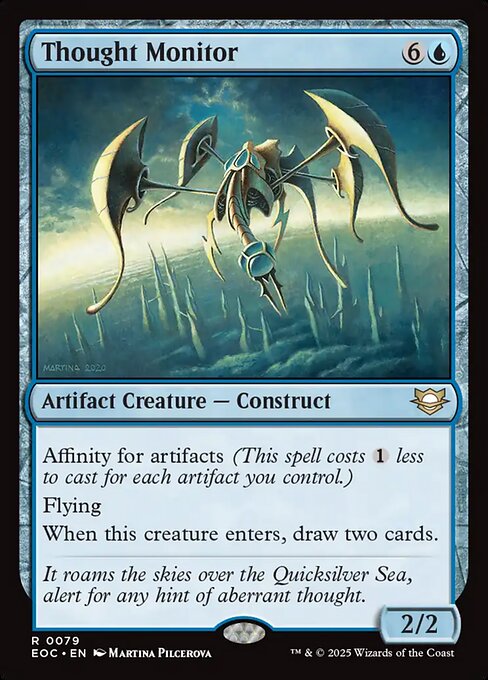
Stock Buckle Up already contains Thoughtcast and Universal Surveillance. Thought Monitor is absent and offers a possible replacement for Surveillance when the deck wants a creature and a smaller fixed draw. Monitor costs six generic and one blue before affinity for artifacts, has flying, and draws two when it enters. With four artifacts contributing to the cost reduction, its ordinary cost becomes two generic and one blue.
Universal Surveillance costs X plus three blue and has improvise. Choosing X as four gives a starting payment of four generic and three blue, before using suitable untapped artifacts for the generic portion. Improvise does not erase the three blue symbols. An artifact tapped for mana is not also untapped and available to pay improvise. The card can draw more than Monitor, but the colored requirements and the board it asks for are different.
The printed curve can be misleading in both directions. Monitor looks like a seven-mana spell but can cost less in an artifact board. Surveillance has a printed X cost and still needs mana or artifact payments for the chosen draw. The comparison loses Surveillance’s scalable burst and gains a flying artifact creature that can contribute to crew costs after it enters. If Monitor is countered before entering, its draw trigger does not happen.
Draw options by what they require

Tocasia's Welcome
Small creature entries
Checks mana value three or less and triggers only once each turn. Ordinary creature tokens usually have mana value zero.
Bennie Bracks, Zoologist
Token creation during the turn
Looks back over the current turn at each end step. An old token alone does not satisfy the condition on a later turn.

Idol of Oblivion
Token event and a usable tap
Provides a chosen activation rather than an automatic end-step draw. Creature animation can change tap restrictions.

Morbid Opportunist
Other creatures dying
Can use opposing deaths but has a once-each-turn limit and does not reward its own death.

Night's Whisper
Mana and life loss
Gives cards without a creature or token condition. The life loss happens as part of resolution.

Deadly Dispute
Artifact or creature sacrifice
Pays the sacrifice during casting. A countered spell does not return the spent permanent.
Thought Monitor
Artifact-supported casting
Affinity can reduce generic mana while leaving blue payable. Drawing depends on the creature entering.
Test the engine without assuming its best board
Start from three positions: a normal developing board, a board with the commander removed, and a position after a wipe. Check whether the proposed card draws now, needs another card, or remains too expensive. This is a rehearsal of conditions rather than a measured win-rate test. It can reveal that a lower-cost burst spell covers a gap that another powerful engine would leave untouched.
Keep the named cut and record what you missed from it: Banner’s power bonus, Augur’s burst, or Surveillance’s scaling. Create a free account to save the original and revised lists in My Decks. Use the Commander deck audit to review the surrounding mana and support, then choose the next edit from actual repeated failures rather than adding every card labeled draw.
Build your deck
Put these choices into a Commander list. Create a free account to save your deck and keep tuning it with Deckcipher.
FAQ
Should every precon replace its expensive draw spells?
No. An expensive burst can refill after development or reward a large board. Compare when it is castable and what resource it needs. Keep useful scaling when the deck can support it, while adding independent draw if empty-board turns are the recurring problem.
Does Tocasia’s Welcome draw once for each token?
No. Its ability triggers only once each turn, even when several qualifying creatures enter together or at different times that turn. It checks mana value three or less rather than power.
Why can Welcoming Vampire miss an Éowyn token?
It checks the entering creature’s power after applicable bonuses. A normal 2/2 Human Knight receiving Coppercoat Vanguard’s +1/+0 has power three and does not qualify. Its mana value can still qualify for Tocasia’s Welcome.
Do I need to keep the token for Bennie or Idol?
The relevant condition is that you created a token during that turn, not that it remains. A token created on a previous turn does not establish a fresh event on the current turn. Each card also needs its own timing and activation conditions.
Can opponents remove my creature before I sacrifice it to Village Rites?
The sacrifice is an additional casting cost. Once casting is complete and opponents can respond, that permanent has already been sacrificed. They can counter the spell, and the cost remains paid.
Does Skullclamp kill a plain 2/2 token?
No. It becomes 3/1 from the equipment’s +1/-1. It needs another reason to die before the draw trigger happens. Check current toughness and any lord bonuses rather than assuming all small tokens die when equipped.
Does Thought Monitor always cost one blue?
No. Its generic cost reduction depends on artifacts you control during the casting-cost calculation. With four artifacts it normally costs two generic and one blue. You still need to pay any remaining cost and resolve the creature for its entry draw.
How many new draw cards should I buy first?
Begin with the missing function and a small enough change to evaluate. One reliable burst spell or one better-matched engine can matter more than replacing the whole package. Check the current deck and stock list to avoid purchasing an unnecessary duplicate.