
Quick answer
Orzhov staples should combine white coverage and protection with black cards, sacrifice, and recursion. Anguished Unmaking, Despark, Skullclamp, and a compatible death payoff are useful starting comparisons. Decide whether the deck wins through creature deaths, lifegain, combat, or a different engine before adding every card that mentions life.
Black-white needs a resource loop and a destination
Orzhov is the white-black color pair. It can answer many permanent types, exchange life for resources, gain life through creatures or spells, and recover useful creatures. Those tools support aristocrats, lifegain, tokens, reanimation, enchantments, and combat. The challenge is not finding powerful cards. It is choosing a package that supplies the resource the commander needs and turns it into a clear finish.
A death-trigger commander needs creatures, outlets, and payoffs. A lifegain commander may care about the number of separate lifegain events rather than the total life gained. A reanimation commander needs targets and setup. These distinctions determine which apparent staples work. An expensive payoff that sees the wrong event can be less useful than a modest enabler that keeps the engine running every turn.
Do not make every support slot conditional on the commander surviving. Black provides draw that can work without a board, while white supplies efficient answers and recovery options. Keep some of that independence. A resilient list can redeploy a producer after a wipe, draw cards without sacrificing its last creature, and answer a troublesome enchantment before it rebuilds the full engine.
Orzhov candidates by job

Anguished Unmaking
Broad exile
Exiles a targeted nonland permanent, and you lose three life when the spell resolves. The life loss is not a casting-cost payment. It cannot exile a land.

Despark
Efficient restricted exile
Exiles a permanent with mana value four or greater. It can miss a cheap but crucial engine.

Mortify
Creature or enchantment removal
Destroys a creature or enchantment. It does not cover artifacts and does not bypass indestructible.
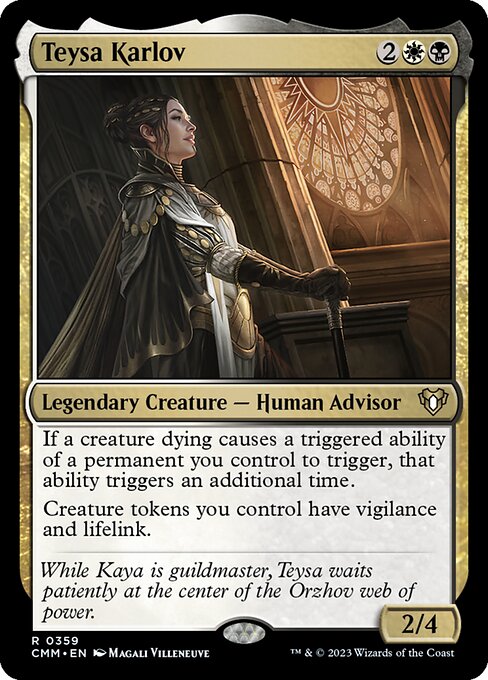
Teysa Karlov
Death-trigger support
Can double qualifying death-triggered abilities of permanents you control. It needs actual death triggers and is not a sacrifice outlet.

Elas il-Kor, Sadistic Pilgrim
Creature-entry and death payoff
Rewards other creatures you control entering with life and dying with opposing life loss. The two events do different work.

Skullclamp
Creature-based card access
Can turn expendable creatures into cards, but needs equip mana and creatures that actually die.
Exploit broad coverage without overpaying for every answer
Anguished Unmaking can exile a nonland permanent, including an indestructible creature or a troublesome enchantment, and causes you to lose three life on resolution. Despark is cheaper but only targets a permanent with mana value four or greater. A low-cost commander or combo piece can be outside Despark's reach. The restriction matters more than the fact that both spells have the word exile.
Mortify covers creatures and enchantments through destruction. Vindicate can destroy any permanent but is a sorcery. Swords to Plowshares handles a creature for one white mana, while Feed the Swarm can cover an opposing enchantment at sorcery speed and a life cost. Compare the actual threat types and timing your list needs. You do not have to pay three mana for every creature answer just because Orzhov offers flexible three-mana spells.
A useful first package combines cheap creature interaction with some broad noncreature coverage. Graveyard interaction and protection remain separate needs. Exiling one opposing creature does not prevent another player returning several creatures from a graveyard, and destroying an artifact after its ability has been activated does not automatically counter that ability. Use Interaction Checker to review categories, then apply the precise text to the threats your games produce.
Assemble aristocrats from producers, outlets, and payoffs
Viscera Seer and Carrion Feeder provide repeatable creature sacrifice outlets with different results. Seer scries, while Feeder grows through counters and cannot block. Neither creates the creature it sacrifices. Blood Artist, Zulaport Cutthroat, and Elas il-Kor reward deaths in different ways. A death-payoff card sitting beside another payoff is not a working engine without a supply and a way to create the relevant events.
Blood Artist can see other players' creatures die and targets a player. Zulaport Cutthroat focuses on your creatures and affects each opponent without targeting them individually. Elas rewards other creatures you control entering and dying. Check whether a payoff sees tokens, whether it says another, and whether it limits triggers each turn. Those clauses affect how much fodder the deck needs and whether the commander itself contributes to a reset.
Teysa Karlov can add another occurrence of a qualifying triggered ability when a creature dying causes it to trigger. It does not double every sacrifice ability. Sacrificing a Treasure is not a creature dying unless that Treasure was also a creature, and a reward for sacrificing an artifact can have a different trigger condition. Treat Teysa as support for a verified set of death triggers rather than a blanket multiplier for anything that mentions sacrifice.
Do not confuse lifegain with a win condition
Soul Warden can generate life from creatures entering, while Soul's Attendant offers a similar optional trigger. Separate events can matter for a commander that rewards each time you gain life. Gaining ten life once is not automatically ten lifegain events. A lifelink creature dealing damage can create life gain through its damage, but the relevant event still depends on how that damage occurs.
A lifegain deck needs something useful to do with the resource. Life can pay black draw costs, support a payoff, or buy time for an engine. It does not itself remove opponents or keep you safe from commander damage, poison, or alternate losses. A deck can reach a large life total and still have no way to end the game. Add a finish that the existing cards actually support rather than assuming more life is the destination.
Kambal, Consul of Allocation can turn opponents' noncreature spell casts into life loss and life gain. Creature-heavy opponents give it fewer opportunities, and it does not punish your own casts through that trigger. It can be a useful engine or pressure piece in the right environment without being unconditional life every turn. Evaluate the expected events rather than relying on an optimistic total from an imagined table.
Use life-paid draw with a recovery budget
Night's Whisper provides independent access to two cards for mana and life. Village Rites and Deadly Dispute need sacrifice material, with the sacrifice paid as an additional cost. Black Market Connections triggers at the beginning of your first main phase. Its chosen modes supply resources and cause their stated life losses during resolution; those losses are not life-payment costs. The best choice depends on whether you need raw cards, a body, a Treasure, or an immediate answer, not whether you can select every option.
White draw engines can reward the creatures you already make. Welcoming Vampire checks other creatures with power two or less entering under your control and triggers only once each turn. Tocasia's Welcome checks mana value and also has a once-per-turn limit. A large token batch does not draw for every token from either. Skullclamp can draw repeatedly if you can equip and sacrifice or kill suitable creatures, but a creature with more than one toughness may need an outlet rather than dying from the equipment alone.
A deck that gains life naturally can afford some payments more comfortably, but future lifegain is not guaranteed. Add the costs of several engines before choosing a line. If you pay life for cards, pay more to remove a permanent, and then lose the lifegain creature, combat can become dangerous. Keep enough mana and interaction to turn the new cards into a stable position instead of merely filling your hand at a precarious life total.
Recursion should recover the resources you spend
Reanimate can return a creature from any graveyard and costs life based on its mana value. Victimize targets two creatures in your graveyard and requires a creature to sacrifice during resolution, returning those targets tapped. The creature sacrificed then cannot be one of the already chosen targets. A deck with expendable tokens may support Victimize naturally; a creature-light lifegain list may not.
Sun Titan can return a permanent card with mana value three or less from your graveyard to the battlefield when it enters or attacks. That can recover a cheap producer, draw engine, outlet, or land. Sevinne's Reclamation offers another route for a similar permanent range, with a different cost and flashback sequence. Neither returns arbitrary expensive creatures or an instant. List the actual targets before treating a recovery card as a staple.
Athreos, God of Passage can create a return-to-hand choice when another creature you own dies, unless a targeted opponent pays life. A token does not become a reusable creature card because Athreos triggered. Opponents can make different choices depending on the creature and life totals, so it is not guaranteed recursion. Keep a backup route when the commander gives opponents agency over which resources return.
Mana rocks must cast the white and black spells
Orzhov commonly uses Arcane Signet, Talisman of Hierarchy, Orzhov Signet, and other artifacts for early acceleration. The Talisman taps for one mana directly, while dealing one damage to you for colored mana. The Signet needs one input mana to produce white plus black. Sol Ring provides colorless mana and cannot pay a double-white or double-black requirement by itself. These details determine whether a proposed early line is legal.
Caves of Koilos can supply either color at a life cost or colorless without that payment. Isolated Chapel checks for a Plains or Swamp. Shineshadow Snarl can enter untapped when you reveal an appropriate land card from hand. Each creates different opening sequences. Use Mana Base Calculator to inspect early colored access rather than assuming that a two-color deck cannot have fixing problems.
Cabal Coffers needs an activation payment and counts Swamps you control. A two-color list with many non-Swamp lands may not support it as well as mono-black. Urborg, Tomb of Yawgmoth can change that count, but the pair is still two separate cards and can help opponents too. Do not replace a reliable early source with a conditional late engine unless the deck can tolerate the weaker opening.
Choose protection and wipes as one package
White can protect a valuable board through phasing or indestructible effects, while black can help recover creatures afterward. Those are different routes. Teferi's Protection phases permanents rather than causing them to leave and reenter. Heroic Intervention is outside Orzhov color identity unless the commander also has green, so do not import it from a generic aristocrats list. Choose legal protection that suits the actual commander.
Wrath of God destroys creatures and prevents regeneration. Toxic Deluge gives a toughness reduction and can remove indestructible creatures when their toughness becomes zero or less. Farewell can exile selected categories, potentially including your own graveyard. A recursion deck that selects every Farewell mode may remove the very resources it intended to use after the reset. Choose the recovery route before choosing the wipe.
Inkshield can prevent combat damage dealt to you during the turn and create flying creature tokens from the prevented damage. It does not prevent arbitrary noncombat damage or protect every permanent. Holding five mana for it is a different plan from deploying another engine. It can be an impressive combat swing when opponents attack, but is conditional on that event and may do little against a spell-based finish.
Add a finish that follows normal turns
An aristocrats deck can use repeated deaths to drain opponents, while a token deck can close through combat with an appropriate team boost or evasion. A lifegain deck may choose a separate life-based payoff. A reanimator deck may use recurring large creatures. Choose the route that the rest of the list prepares. Combining all four can consume slots without giving any one plan enough support.
If the list includes a repeatable loop, verify the resource balance. Returning a creature and sacrificing it again is not infinite if every return costs more mana than the sequence produces. A death trigger may supply life loss without supplying the missing mana. A once-per-turn restriction can break an otherwise plausible loop. Check the exact cards and explain the finish before describing it as a compact engine.
Clear pregame communication matters when repeated sacrifice, taxing, or life-drain effects substantially shape the game. A slow-looking deck can still have a deterministic finish. Conversely, a list with several powerful cards may primarily win through combat. Use the actual plan when explaining the deck. A staple package should make that plan reliable while leaving enough interaction and draw to keep the game moving.
Make swaps that improve the resource chain
| Problem in the list | Comparison to test | What you give up |
|---|---|---|
| Several payoffs, no sacrifice control | A redundant drain creature to Viscera Seer | Less passive damage, more control over deaths |
| Draw requires a creature you cannot spare | A sacrifice draw spell to Night's Whisper | Independent access loses sacrifice timing |
| Removal misses a cheap engine | An extra Despark-style restriction to broader coverage | Often more mana or life |
| Repeated wipes erase your graveyard plan | A redundant exile wipe to recovery or protection | Less universal reset power, better engine continuity |
Keep the original version and change the package that actually fails. If a deck cannot produce fodder, another premium payoff is unlikely to fix it. If it has creatures but runs out of cards, compare a compatible engine before increasing the token total. Price the actual printing and the whole upgrade package, since a fixed label cannot guarantee checkout cost. A balanced collection of ordinary role cards can support the commander better than one isolated premium enchantment.
Frequently asked questions about Orzhov staples
Build your deck
Put these choices into a Commander list. Create a free account to save your deck and keep tuning it with Deckcipher.
FAQ
Is every Orzhov deck an aristocrats deck?
No. Black-white also supports lifegain, tokens, reanimation, enchantments, and combat. Sacrifice cards need a supply, an outlet, and payoffs to work together. A commander that rewards a different event may prefer a smaller death package or none at all.
Does Teysa Karlov double every sacrifice reward?
No. Its relevant ability applies when a creature dying causes a triggered ability of a permanent you control to trigger. A noncreature Treasure being sacrificed is not automatically a creature death, and a sacrifice-related trigger can have different wording. Check the actual event and card text.
Can Despark remove any nonland permanent?
No. It targets a permanent with mana value four or greater. Cheap engines and many commanders can be outside that restriction. Anguished Unmaking has broader nonland coverage at a higher mana and life cost. Compare target range rather than treating both exile spells as identical.
Does gaining life stop commander damage losses?
No. Life gained does not erase combat damage previously dealt by a particular commander for the commander-damage rule. A high life total also does not stop poison or every alternate loss condition. Lifegain is a resource and buffer, not universal protection.
Does Inkshield protect the entire board?
No. It prevents combat damage that would be dealt to you that turn and creates tokens based on damage prevented this way. It does not generally prevent noncombat damage or save every permanent from a wipe. Its ceiling depends on the attack and the available mana.
What is the best first Orzhov upgrade?
Find the missing link in the resource chain. Add production if outlets and payoffs lack fodder, independent draw if the hand stalls, or broader interaction if one permanent type repeatedly stops the deck. Fix that ordinary failure before multiplying a payoff the deck cannot use reliably.
Build an Orzhov list with a workable exchange
Build your deck around the death, lifegain, or recovery engine you chose. Create a free account to save the list and return to that version as you compare mana, curve, and interaction. Mark what each staple spends and what it produces. A useful black-white package gives you something to exchange, a reason to exchange it, and a way to continue when the first engine is removed.