
Quick answer
Gruul staples should turn green mana development into red-green pressure, with enough draw and interaction to keep the deck moving. Nature's Lore, Beast Within, Rhythm of the Wild, and Return of the Wildspeaker are useful comparisons. Choose between one large attacker, a wide board, lands, or another engine before buying a stack of finishers.
Red-green needs a plan beyond large creatures
Gruul is the red-green color pair. Green can develop lands and creatures, while red can supply haste, artifact answers, temporary resources, and damage. The combination can play impressive threats, but a deck full of impressive threats may still spend turns doing nothing. Decide how the list moves from early resources to pressure and how it continues after a removal spell or board wipe.
A Xenagos, God of Revels deck wants a different threat package from a token deck. A lands commander may use ramp as both mana development and an engine trigger. A mana-creature commander can turn small accelerators into combat resources. Those strategies share useful support cards, yet their ideal card draw and finishing turns differ. Start with the commander's repeated action rather than assuming Gruul means the same curve in every deck.
The most helpful staples often bridge two stages of the game. A draw spell that uses a large creature can connect a threat to more resources. A haste enabler can make a newly cast creature matter before opponents untap. Flexible interaction can remove the enchantment that prevents attacking. Build those connections first. A second expensive finisher does less if the deck still lacks a way to cast, protect, or replace its first one.
Gruul cards worth comparing
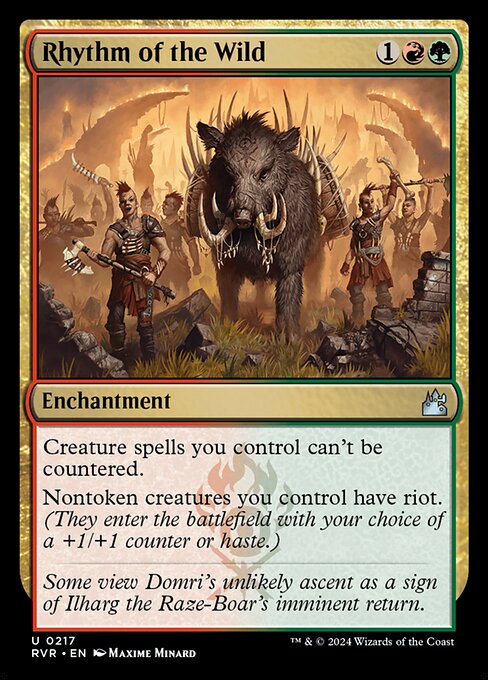
Rhythm of the Wild
Creature support
Makes your creature spells unable to be countered and gives nontoken creatures you control riot. It does not give every creature haste automatically.

Hull Breach
Permanent coverage
At sorcery speed, destroys an artifact, an enchantment, or one of each. Its flexibility can save slots, but it cannot be held up as an instant.

Cindervines
Pressure and interaction
Punishes opposing noncreature spell casts and can be sacrificed with mana to destroy an artifact or enchantment. It is not repeated removal after sacrificing itself.
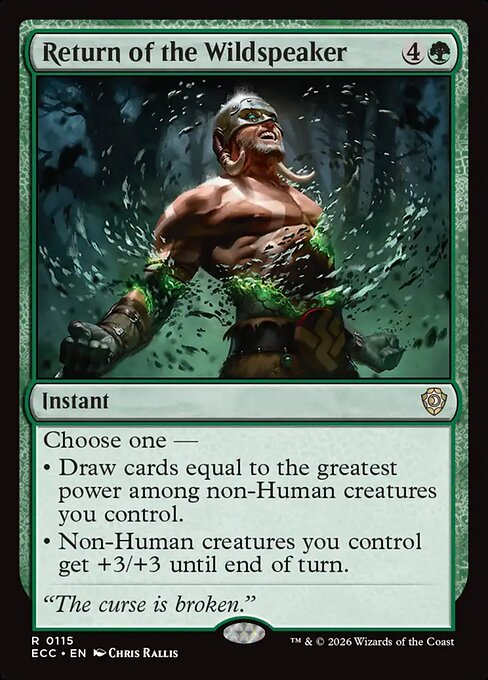
Return of the Wildspeaker
Draw or combat
Can draw based on the greatest power among your non-Humans, or pump your non-Human creatures. Check creature types and board dependence.

Kessig Wolf Run
Combat mana sink
Uses mana and a tap to give a creature extra power and trample for the turn. Its colored activation is not free.

Beast Within
Broad answer
Destroys a permanent and supplies a 3/3 Beast to its controller. Useful against a wide range of problems, with destruction limits.
Choose acceleration for the turn you need
Llanowar Elves and Birds of Paradise can accelerate early, but creatures with tap abilities normally cannot tap for mana the turn they enter unless they have haste. Their low cost is useful when it moves the commander forward a turn. Their vulnerability matters when a sweeper removes both your threats and your mana. A deck that repeatedly loses all its acceleration can mix in land-based ramp rather than simply adding more mana creatures.
Nature's Lore and Three Visits find a Forest card, which can be a dual land with the Forest subtype. The spells do not force that land tapped, although the land's own entry condition still applies. Farseek can find a Plains, Island, Swamp, or Mountain card and puts it onto the battlefield tapped. In Gruul, it can find a Mountain or an appropriate typed dual, including a Forest dual that also has Mountain. Check the actual targets rather than calling all two-mana ramp equivalent.
Cultivate and Kodama's Reach provide one basic land to the battlefield tapped and another to hand. They cost three, so they fill a different timing role from a two-mana accelerator. Skyshroud Claim costs four and can find two Forest cards. It can be appropriate in a deck with expensive payoffs, but it is still a setup turn. Count which spells the acceleration lets you cast next, not just how many ramp cards appear in the list.
Use draw that survives the shape of your board
Garruk's Uprising draws when it enters if you control a creature with power four or greater and can draw when qualifying creatures enter afterward. It also grants trample. Elemental Bond uses a different power threshold for creatures entering and does not provide the same other benefits. A deck full of small tokens may have trouble using either without an anthem, while a large-creature list may trigger them naturally.
Guardian Project cares about qualifying nontoken creatures entering, including its same-name condition involving your battlefield and graveyard. Beast Whisperer instead triggers when you cast a creature spell. That distinction matters when a commander puts creatures onto the battlefield without casting them or when an opponent counters the creature spell. Choose the engine that follows your actual sequence rather than treating entry and cast triggers as synonyms.
Return of the Wildspeaker can turn a large non-Human into a refill or help a non-Human team attack. Rishkar's Expertise draws based on the greatest power among your creatures and may allow a lower-cost spell from hand without paying its mana cost. Both depend on the board. Keep some card access that still works after a wipe if the commander does not provide it. Harmonize is less synergistic but does not require a creature to survive until resolution.
Haste, trample, and protection are separate jobs
A large creature with no evasion can be held back by a small disposable blocker. A powerful threat without haste may give every opponent a turn to answer it before it attacks. A haste enabler can solve the second problem without solving the first. Check each creature's actual route to damage, especially in a deck investing most of a turn into one threat.
Rhythm of the Wild gives nontoken creatures you control riot. Each qualifying creature enters with your choice of a plus-one counter or haste, so the choice is part of the card's value. Tokens do not receive riot from Rhythm. It also makes creature spells you control unable to be countered, but that does not stop removal after they resolve. Do not count it as complete protection for every permanent or as a global haste ability for the board you already controlled.
Heroic Intervention gives your permanents hexproof and indestructible for the turn. It can preserve an army through destruction, but not a nontargeting exile effect or a toughness reduction that leaves creatures at zero toughness. Tamiyo's Safekeeping protects one permanent with a smaller mana requirement. The appropriate choice depends on whether the deck needs one engine to survive or a whole army. Protection still requires leaving the mana available on the relevant turn.
Keep answers for creatures and noncreature engines
Beast Within can destroy any permanent and supplies a Beast token. It can remove a land or an enchantment that a creature-only answer misses, but indestructible still matters. Chaos Warp offers another broad route and carries the possibility of a revealed replacement permanent. The two cards have different risks. Broad coverage is useful because a Gruul deck can otherwise lose to a permanent that prevents combat or disables the engine.
Hull Breach and Cindervines are multicolor options for artifacts and enchantments. Hull Breach offers a two-target mode but is a sorcery. Cindervines can create damage pressure from opposing noncreature casts and later sacrifice itself for targeted removal. Neither should be mistaken for unlimited repeated answers. Krosan Grip has split second while on the stack, but triggered abilities and mana abilities can still function. It does not say that no game action can occur.
Red damage-based creature removal needs realistic targets. Abrade can damage a creature or destroy an artifact. Blasphemous Act can reset many creature boards through damage, but does not clear indestructible creatures by damage alone. Green fight spells need a suitable creature and can expose two of your resources to one opposing response. Use the Interaction Checker to look for coverage gaps rather than assuming big creatures handle every opposing threat.
Wide boards and single attackers want different finishers
Overwhelming Stampede scales its team bonus with the greatest power among creatures you control and grants trample. It asks for an existing board worth attacking with. Craterhoof Behemoth similarly rewards creature count through its entry trigger. A deck with only one important creature may want a different damage plan rather than using the same finisher package as a token deck.
Xenagos, God of Revels targets another creature you control at the beginning of combat on your turn, gives haste, and increases power and toughness based on its power when the trigger resolves. It wants a worthwhile attacker and can be interrupted. Pumping a creature before that trigger resolves can change the size of the bonus, but it is not a reason to fill the deck with temporary pump at the expense of draw and threats. The sequence needs the creature to remain available.
A token or mana-creature deck may prefer a team pump, repeated combat pressure, or a damage payoff that rewards multiple bodies. A single-attacker deck may prioritize trample, protection, and a threat with an immediate cast or entry effect. A landfall deck can use repeated land triggers for damage or creatures. Select the finish that the ordinary turns already prepare instead of forcing a second unrelated win package into the same slots.
Land engines and mana creatures change staple value
A lands-focused Gruul deck can treat Cultivate, fetch lands, or recursion as engine pieces because lands entering may trigger useful effects. Extra-land-play permissions such as Exploration require lands available to play. They do not find those lands for you. A deck with several extra-play effects and too few lands can create the appearance of acceleration without actually increasing resources.
A mana-creature plan may favor effects that turn accelerators into attackers. Raggadragga, Goreguts Boss rewards creatures with mana abilities and can change how a Birds of Paradise contributes later. That is a commander-specific reason to retain small creatures that another Gruul deck might replace with land ramp. Do not describe a mana creature as universally weak late when the chosen commander can convert it into pressure.
These engines also recover differently. Lands often survive creature wipes, while a mana-creature deck can lose its development with its army. A graveyard land engine may be vulnerable to exile even when its battlefield looks stable. Include a recovery card or alternate resource route that matches the vulnerability. Another payoff will not fix a list whose entire engine disappears to the same common answer.
Use the mana base as a spell-support system
Kessig Wolf Run can be a useful mana sink that turns extra resources into power and trample. Its activation requires red, green, X, and tapping the land. That land is not simultaneously available to make mana for its own activation. A utility land can improve late turns while making an early colored spell harder to cast. Count that cost, especially if the commander or support cards have multiple colored pips.
Karplusan Forest can supply either color at a life cost or colorless without that payment. Rootbound Crag checks for a Mountain or Forest, while Cinder Glade checks for two basic lands to enter untapped. Typed duals can improve Forest-search spells, but they also have their own entry conditions. Use Mana Base Calculator to compare the actual source mix and the spells you intend to cast early.
Do not solve every missed land drop by adding another ramp spell. The ramp needs lands to cast it, and a hand with only expensive acceleration can still be slow. Review land count, early sources, draw, and curve together. If your hand makes plenty of mana but has nothing worth casting, another resource card may make the problem worse. The best upgrade might be an engine or a lower-cost threat.
Make role-preserving cuts
| Current bottleneck | Comparison to test | Tradeoff |
|---|---|---|
| A large creature waits a full turn to matter | A redundant large threat to Rhythm of the Wild | Less threat density, earlier impact from qualifying future creatures |
| The deck ramps and then empties its hand | An extra finisher to compatible creature draw | Needs the relevant cast or entry events |
| Damage answers miss an enchantment | A narrow burn spell to Beast Within | A replacement Beast and higher mana cost |
| Mana creatures vanish with every wipe | Some creature ramp to land ramp | Different speed and fewer bodies for creature synergies |
These are examples to apply only when the problem exists in your list. Save the original version, change one role at a time, and watch what happens in ordinary turns. Do not assume the most expensive finisher is the next purchase. A reliable cheap engine or source upgrade may make more hands function than one premium threat. Current printing prices vary, so compare the actual package cost rather than relying on a fixed price label.
Frequently asked questions about Gruul staples
Build your deck
Create a free Deckcipher account to save this Commander list and compare each change with the connected tools.
FAQ
Does Rhythm of the Wild give tokens haste?
No. Its riot ability applies to nontoken creatures you control. A qualifying creature can enter with haste or a plus-one counter through riot, but tokens do not get that ability from Rhythm. The enchantment also makes your creature spells unable to be countered; those are separate benefits.
Should a Gruul deck use creatures or land ramp?
Both are viable. Cheap mana creatures can improve commander timing and creature synergies, while land ramp often survives creature wipes and can fix colors. Use the mixture that fits the commander and the disruption you face. Count the early mana cost and the later recovery cost.
Can Farseek find a Forest dual land?
Yes, if that land also has a type Farseek lists, such as Mountain. It cannot find a plain basic Forest. Farseek puts the chosen land onto the battlefield tapped. Nature's Lore and Three Visits instead search for a Forest card and do not themselves force it tapped.
Does Gruul need a combat finisher?
It needs a way to close that fits its plan. Many Gruul decks use combat, but landfall damage, sacrifice, or other engines can provide a different route. A team pump belongs in a deck that normally has a team. A single-attacker deck needs a different balance of threats and support.
Does Heroic Intervention stop Farewell?
Not if Farewell exiles the relevant permanents through its selected modes. Hexproof does not stop a nontargeting effect, and indestructible does not prevent exile. Use protection that matches the threat or retain a recovery plan. No single protection spell covers every board reset.
What is the usual Gruul deckbuilding trap?
Overloading on ramp and expensive threats while leaving too little draw, removal, or evasion. The deck can make a large creature and still have no useful follow-up or path through blockers. Build the links between resources, pressure, and recovery before adding another top-end card.
Build a red-green list with connected turns
Build your deck around the pressure plan you chose, then create a free account to save it. Use the connected tools to compare mana, curve, and interaction without losing that version of the list. Give every staple a concrete job: an earlier commander, a refill after a threat, a clear attack, or a way to recover. Gruul works best when those jobs lead naturally into each other.
Ruric Thar, the Unbowed creates a further exception to a generic support package. Its trigger punishes a player who casts a noncreature spell, including you. A creature-heavy build can prefer creature-based draw and removal for that reason, while still retaining the few noncreature answers it truly needs. Count that self-inflicted damage when choosing a protection or draw spell rather than assuming a famous noncreature staple has no additional cost.