
Quick answer
Golgari staples should connect green mana and permanent value with black draw, removal, and creature recovery. Assassin's Trophy, Abrupt Decay, Eternal Witness, and a compatible death-draw engine are useful comparisons. Decide whether the graveyard supplies lands, creatures, or general value, then preserve a plan that still works when an opponent exiles it.
Choose what black-green wants from the graveyard
Golgari is the black-green color pair. It can develop lands, use creatures as resources, remove many permanent types, and reuse cards from the graveyard. Its decks can focus on sacrifice, land recursion, reanimation, counters, tokens, or ordinary creature value. Those strategies share some support, but they do not need the same graveyard setup. A card that mills creatures may be useful in one list and remove needed spells from access in another.
Start by deciding what the commander turns into value. Does it want creatures dying, lands entering, cards leaving the graveyard, or a particular creature type? Then supply that event consistently. A deck with several expensive recursion effects and few useful targets can stall as badly as a deck with targets and no return spell. The engine needs connected resources, not merely many cards with a graveyard theme.
Green offers reliable development and permanent-based draw, while black offers life-paid access and creature removal. The pair can cover its basic needs without making every card conditional on a stocked graveyard. Keep some independent draw, ordinary land ramp, and creatures you can cast. Graveyard synergy is an advantage when it creates more options, rather than a requirement that prevents the deck functioning after one exile effect.
Golgari cards to compare first

Assassin's Trophy
Broad removal
Destroys an opposing permanent and lets its controller search for a basic land. That land is not forced tapped by the spell.
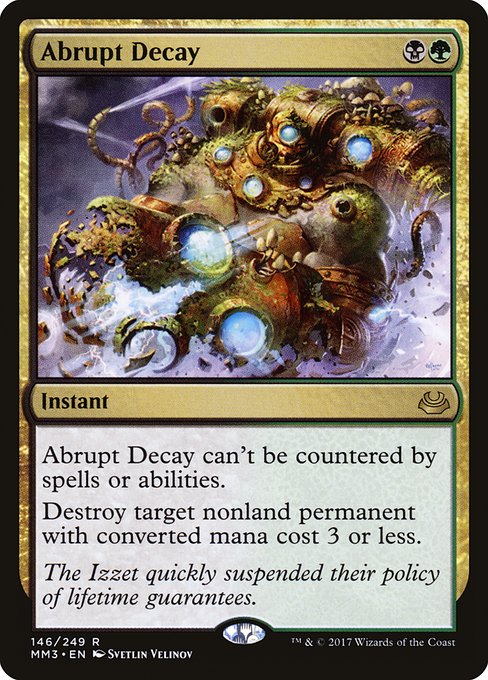
Abrupt Decay
Cheap restricted answer
Cannot be countered and destroys a nonland permanent with mana value three or less. It misses larger engines and indestructible.

Tear Asunder
Exile coverage
Exiles an artifact or enchantment normally. Its kicker expands the target range to a nonland permanent at an additional cost.
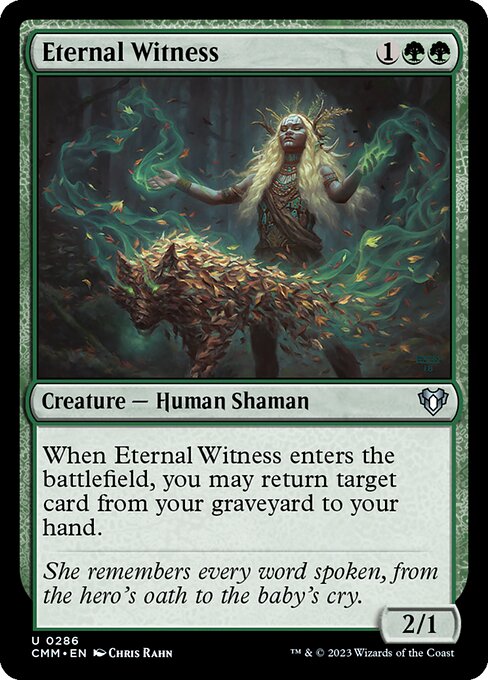
Eternal Witness
Flexible recovery
Returns a card from your graveyard to hand when it enters. It does not put that card directly onto the battlefield.

Moldervine Reclamation
Death-based draw
Rewards your creatures dying with life and a card. It costs five mana and needs actual deaths afterward.

Deathreap Ritual
Turn-based card access
At an end step, a creature having died that turn can enable one optional draw. It is not a draw for every death.
Use broad answers with clear compensation costs
Assassin's Trophy can destroy any permanent an opponent controls, including a troublesome land. Its controller may search for a basic land and put it onto the battlefield. The spell does not force that land tapped. An early Trophy can therefore accelerate the player you answer. That can be worthwhile against a crucial permanent, but it is a real cost when you are removing an ordinary small creature you could handle more efficiently.
Abrupt Decay has a lower mana-value ceiling and cannot be countered. Its target must be a nonland permanent with mana value three or less. That is useful coverage for many early engines, but not a reason to omit answers to expensive threats. Putrefy destroys an artifact or creature and prevents regeneration. It misses enchantments and does not overcome indestructible. Compare the target ranges before choosing which flexible answer earns the slot.
Tear Asunder normally exiles an artifact or enchantment. Paying its kicker expands the target range to a nonland permanent, and the extra payment belongs in your turn calculation. Exile can matter against indestructible and recursion. Beast Within offers destruction at instant speed with a token drawback. Use the Interaction Checker to review what the package answers, then keep the restrictions and compensation costs visible beside the count.
Develop mana in a way the engine can use
Nature's Lore and Three Visits search for Forest cards, including appropriate typed duals. The spells do not force the land tapped, but the land's own entry conditions still apply. Farseek searches for a Plains, Island, Swamp, or Mountain and puts the chosen card tapped. In Golgari it can find a Swamp or a dual with a listed type, including a Swamp-Forest dual, but not a plain basic Forest.
Sakura-Tribe Elder is a useful bridge between creature and land roles. It can be sacrificed to find a basic land tapped, supplying a death event and a permanent mana source through the same card. It does not need to tap for that ability, so summoning sickness does not prevent the activation. A creature that taps for mana instead normally must wait or have haste. Those differences matter when you plan the early turn.
Cheap mana creatures can support a fast commander or creature count, while land ramp can survive many creature wipes. A sacrifice commander may like a small creature that later becomes fodder, but sacrificing all the mana creatures can leave no resources to rebuild. Use Mana Base Calculator to inspect the colors needed for early green development and black interaction. A large total of green mana does not pay several black pips automatically.
Draw engines should match cast, entry, or death events
Beast Whisperer rewards creature spells you cast. Guardian Project rewards qualifying nontoken creatures entering, including a same-name check involving your battlefield and graveyard. Moldervine Reclamation rewards your creatures dying. All can be strong, but they are not interchangeable. A commander that returns creatures directly to the battlefield can support entry and death engines while missing cast triggers.
Deathreap Ritual offers a draw opportunity at the beginning of each end step if a creature died that turn. One death and several deaths still produce the same single end-step opportunity from one Ritual. It can see a creature belonging to any player, but it is not immediate card access at the moment of death. Check whether the deck expects deaths on multiple turns or mainly one large sacrifice turn.
Night's Whisper and Harmonize are less tied to the engine and can function with no creatures. Village Rites and Deadly Dispute need sacrifice material, paid as an additional cost. A deck can support all those categories, but should not count every conditional option as guaranteed access in an opening hand. Keep at least a clear route to cards after a wipe or graveyard exile leaves the usual engine unavailable.
Self-mill needs a useful destination
Self-mill can put creatures, lands, and other cards into the graveyard, but that is not the same as drawing them. A creature-recursion spell may use one kind of card and leave the rest inaccessible. A land-recursion engine may prefer a high land count and a way to replay those lands. Decide what the mill is meant to supply before adding it as an apparently free value effect.
Satyr Wayfinder can look for a land among a small group of revealed cards and place the rest into the graveyard. Stitcher's Supplier can stock the graveyard when it enters or dies. Both can be useful enablers, but neither guarantees finding the exact target the hand needs. A deck that includes many such cards can spend several turns preparing without actually pressuring the table. Balance setup with access and payoffs.
Dredge is another choice with an opportunity cost. Replacing a draw with a dredge card returns that card from the graveyard to hand and mills the specified number if the library has enough cards. You do not also get the replaced normal draw. Use it when repeating that resource is worth the card you would otherwise draw. Filling the graveyard for its own sake can leave the hand short of lands or interaction.
Reanimation and return-to-hand solve different problems
Reanimate can put a creature from any graveyard onto your battlefield at a life cost based on its mana value. Victimize can return two targeted creature cards from your graveyard tapped after you sacrifice a creature during resolution. The sacrificed creature was not already one of those chosen targets. Animate Dead uses an Aura with its own restrictions and leave-the-battlefield relationship. Choose the package your fodder and targets support.
Eternal Witness returns any card from your graveyard to hand when it enters. Regrowth provides a similar broad return-to-hand result through a sorcery. Those effects can recover a land, removal spell, or protection rather than only a creature. They still require you to pay for the recovered card later. A deck with plenty of mana may appreciate that flexibility more than another narrow creature-return spell.
Golgari Findbroker can return a permanent card from your graveyard to hand and has a demanding colored cost. It cannot return an instant or sorcery. Compare that restriction and cost with the body and creature synergies it supplies. A slightly more thematic recursion creature is not always a better staple. Read the actual target range and decide which card you need to recover after the engine is interrupted.
Land recursion must respect land-play limits
Ramunap Excavator lets you play lands from your graveyard, but it does not increase the number of land plays available each turn. An effect that grants extra land plays changes that other part of the sequence. A fetch land can be useful when replayed, but sacrificing it does not grant an additional normal land drop by itself. Count the permission, the land supply, and the remaining land plays separately.
Life from the Loam returns up to three target land cards from your graveyard to hand and has dredge. The returned lands are not put directly onto the battlefield. A deck can use them for future land plays or another resource purpose, but needs a way to turn the repeated access into a useful turn. It is not general recursion for every permanent type just because the graveyard is full.
A lands engine can spend many slots on utility lands and still miss early colors. Colorless lands and lands that sacrifice themselves have opportunity costs. Retain enough reliable sources to cast the recursion and protection that keep the engine working. If the commander needs early green and repeated black later, an attractive utility land should be compared with the colored source it replaces, not treated as a free spell slot.
Sacrifice and tokens need enough actual production
Golgari can use tokens as fodder for sacrifice, death payoffs, and draw. Pitiless Plunderer creates a Treasure when another creature you control dies, while a sacrifice outlet supplies the action that can produce those deaths. The Plunderer does not create an outlet by itself. A Treasure normally makes mana by sacrificing itself, but it is not a creature death unless the token was also a creature.
Chatterfang, Squirrel General changes token production and has a creature-sacrifice ability with its own cost and target. Its presence can alter how a token engine works, but a generic reference to Squirrels does not prove a loop. Verify the exact resource balance, what counts as another creature, whether tokens are produced together, and whether a mana payment is needed on every repetition.
A deck built around death payoffs should preserve some production after a reset. Tokens normally cease to exist after leaving the battlefield and cannot later be returned as creature cards. A recurring nontoken creature can fill a different role from a batch of disposable tokens. Choose the mix that lets the commander keep operating rather than maximizing the number of cards that reward a death without supplying one.
Protect the graveyard and keep an independent plan
Soul-Guide Lantern can exile one targeted graveyard card on entering or exile each opponent's graveyard through a separate sacrifice ability. That can protect your own resources while interrupting another player. A symmetric graveyard exile effect can instead remove your setup as well. Choose deliberately. Graveyard hate is not automatically a contradiction in a graveyard deck; its scope and timing determine the cost.
Heroic Intervention can protect permanents from targeted effects and destruction but does not protect graveyard cards merely because they belong to you. Veil of Summer has specific color and effect coverage, not universal immunity. A counter to a graveyard-exile ability may require a kind of interaction the colors do not easily provide. Sometimes the best protection is not committing every resource to the graveyard at once.
Keep castable threats, draw that works with no board, and a commander-independent mana base. An opponent spending a card to exile your graveyard should create a setback rather than a permanent inability to take turns. Do not measure resilience only by how many return spells the list contains. Several return spells that all lack targets are the same failed plan repeated in multiple slots.
Choose a reset and a finish that fit the engine
Pernicious Deed can destroy artifacts, creatures, and enchantments with mana value up to the chosen X after its activation cost is paid and the enchantment is sacrificed. It can remove your own resources in those categories too. It does not generally clear planeswalkers, and selecting a large X requires a real mana investment. The card rewards planning around what will remain, not simply announcing that all small permanents disappear for free.
Toxic Deluge can reduce creature toughness enough to handle indestructible, at a life cost and with effects on your own creatures. Living Death can recover graveyard creatures while resetting the battlefield, but also uses opposing graveyards. A deck can profit from either without assuming the result is one-sided. Inspect the actual board and graveyards before choosing the reset.
Then identify the finish: repeated deaths and drain, combat from a developed board, a land-based engine, or another verified sequence. Craterhoof Behemoth rewards creature count, not merely having a large graveyard. A drain payoff needs enough deaths or another route to the required life loss. Avoid adding a second unrelated finish that consumes the setup slots the first plan still needs.
Make swaps at the actual bottleneck
| Observed problem | Comparison to test | Tradeoff |
|---|---|---|
| Graveyard full, few useful return targets | A redundant mill effect to appropriate draw or recovery | Less setup volume, more access to needed cards |
| Removal misses a large permanent | A redundant Abrupt Decay-style restriction to broader coverage | Often a larger cost or compensation drawback |
| Death payoffs lack fodder | An extra payoff to a compatible producer | Lower ceiling, a working resource chain |
| One exile effect strands the whole hand | A redundant recursion spell to independent draw | Less graveyard density, a fallback route |
Keep the original list and compare small changes rather than replacing the entire engine. The strongest-looking graveyard card may not solve the hand you repeatedly draw. Fix colors, setup timing, and independent access before purchasing another premium payoff. Current printing prices vary, so compare the real package cost. A useful upgrade increases the number of ordinary turns where the commander can act, not merely the size of the ideal graveyard.
Frequently asked questions about Golgari staples
Build your deck
Put these choices into a Commander list. Create a free account to save your deck and keep tuning it with Deckcipher.
FAQ
Does Assassin's Trophy put the basic land in tapped?
The spell does not force the searched basic land tapped. That can give the opponent an immediately useful resource, depending on the land and other effects. Trophy is broad removal, but its compensation matters. Use a more restricted answer when it efficiently solves the target you actually need to remove.
Does Abrupt Decay remove every permanent?
No. It targets a nonland permanent with mana value three or less and destroys it. Its uncounterable clause helps it resolve through counters but does not expand the target range or bypass indestructible. Keep another answer for larger threats.
Does dredge also give me my normal draw?
No. Dredge replaces the draw with its own action when you choose to use it and meet the requirements. You return the dredge card and mill the listed number rather than taking that normal draw. Choose the replacement because you need that resource, not because filling the graveyard is automatically valuable.
Does Ramunap Excavator give extra land drops?
No. It lets you play lands from your graveyard, but normal land-play limits still apply unless another effect changes them. You need both land access and permission for additional plays if you want to play several lands in one turn.
Does Heroic Intervention protect my graveyard?
No. Its relevant benefits apply to permanents you control. Cards in your graveyard are not permanents on the battlefield. Keep a plan that can recover from graveyard exile rather than assuming board protection covers every resource zone.
What is the main Golgari deckbuilding trap?
Making every card depend on a stocked graveyard while leaving too little independent draw, mana, or pressure. A graveyard engine should create extra options. Retain enough ordinary play that one exile effect causes a setback rather than turning the whole hand into unusable setup.
Build a Golgari list with more than one route back
Build your deck around the creatures, lands, or death events your commander rewards. Create a free account to save the version and compare its mana, interaction, and curve in the connected tools. For every recovery card, name its real target and the cost of using that target afterward. A strong black-green package keeps resources moving without assuming the graveyard will always remain available.