
Quick answer
Dimir staples combine blue selection and counterspells with black removal, sacrifice, and graveyard access. Baleful Strix is a useful defensive value creature, Drown in the Loch is conditional interaction, and Feed the Swarm can cover enchantments. Choose the package that supports your commander instead of assuming every blue-black deck should become the same control or mill list.
Decide what blue-black is trying to assemble
Dimir is the blue-black color pair. It can draw cards, protect a turn on the stack, remove creatures, and recover creatures from graveyards. Its commanders support very different plans, from evasive combat and Rogues to Zombies, theft, reanimation, and spell-based control. A package that is excellent for a creature-light control deck can be clumsy in a deck that needs cheap evasive attackers every turn.
Begin with the commander's resource engine. If combat damage provides cards, use cheap evasive creatures and interaction that clears a path. If the commander reuses creatures, put useful entry effects into the list and retain enough mana to activate the engine. If the deck mills opponents, decide whether milling is the actual win condition or simply a way to supply graveyard targets. Those are different jobs and need different payoff density.
Blue and black both offer excellent card access, so it is possible to overfill that role. Drawing more cards does not help if you cannot produce the right colors or answer the permanent that stops your plan. Reserve slots for mana, noncreature coverage, graveyard interaction, and a clear finish. The best Dimir staple is often the card that fills the least glamorous gap rather than the one with the highest ceiling.
Dimir cards to compare by role
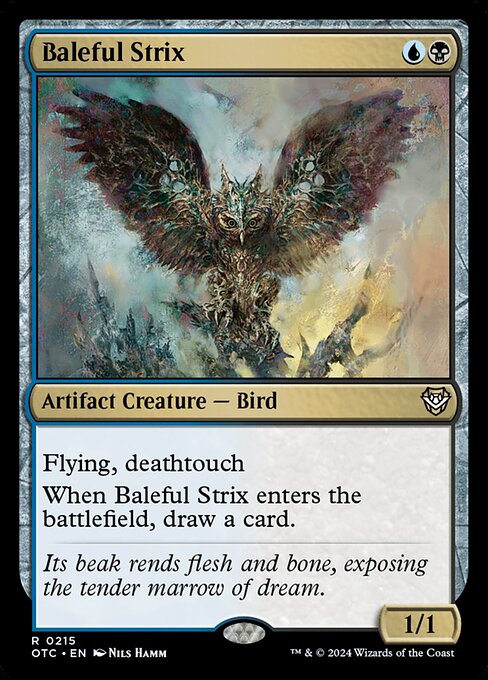
Baleful Strix
Defensive value
Draws when it enters and supplies a flying deathtouch blocker. It does not remove a creature simply by entering.
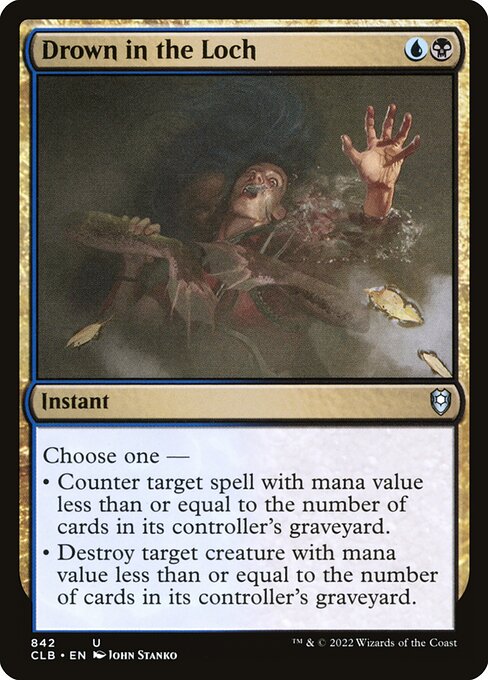
Drown in the Loch
Conditional interaction
Can counter a spell or destroy a creature if its mana value is within the relevant controller's graveyard-card count.
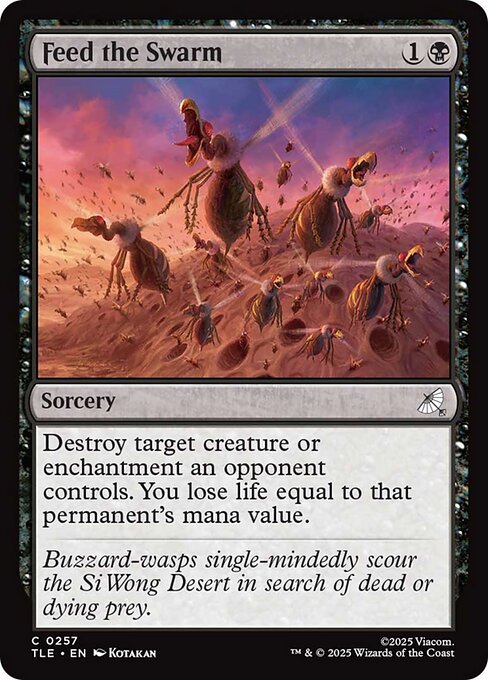
Feed the Swarm
Enchantment coverage
Sorcery-speed removal for an opposing creature or enchantment, with a life cost.

Reality Shift
Creature exile
Exiles a creature and gives its controller a manifested card. Useful when destruction is insufficient, with a real replacement-body tradeoff.

Talisman of Dominance
Early mana
Produces colorless directly or blue or black while dealing one damage to you. Helps cast a spell while developing the next turn.

Soul-Guide Lantern
Graveyard control
Its entry ability exiles one graveyard card; its sacrifice ability exiles opponents' graveyards while leaving yours alone.
Use stack interaction without neglecting the battlefield
Counterspell can stop a spell while it is on the stack, but needs two blue mana. Arcane Denial is easier to cast in a mixed-color opening and compensates the opposing spell's controller with cards. Negate covers noncreature spells. Swan Song covers enchantments, instants, and sorceries, not an arbitrary creature or artifact spell. Choose the restrictions you can accept instead of treating every two-mana answer as the same card.
Drown in the Loch adds flexibility because it can counter a spell or destroy a creature, but both modes depend on a specific player's graveyard size. For the counter mode, count cards in the spell controller's graveyard. For the destroy mode, count the creature controller's graveyard. Your own self-mill does not automatically enable either mode against an opponent. Exiling that opponent's graveyard can also make Drown weaker at the exact moment you want to cast it.
Keep resolved-permanent answers beside the counters. Infernal Grasp can destroy a creature at a life cost, while Reality Shift can exile one and supplies a manifested replacement. Neither stops an enchantment engine. Feed the Swarm covers that category at sorcery speed. A Dimir list with ten counters and several creature answers can still struggle against a permanent that resolved while the pilot was tapped out. Review the actual coverage with the Interaction Checker.
Count raw cards, selection, and graveyard setup separately
Ponder and Preordain improve selection but do not normally increase the number of cards in your hand. Night's Whisper provides a simple two-card draw at a life cost, independent of your battlefield. Fact or Fiction offers a choice between two piles made from the top five cards and can stock the graveyard with the pile you do not take. These effects have different value depending on whether you need land drops, a particular answer, or resources for a recursion plan.
Brainstorm becomes more attractive with a way to move unwanted cards away from the top of the library. Without that support, it can leave the same unhelpful cards waiting for the next draws. Do not put a cantrip into a draw-engine slot merely because it has the word draw. A deck that spends several cards selecting and never replenishes its hand may still run out of resources.
Rhystic Study and Mystic Remora provide conditional ongoing access. Opponents may pay the relevant costs, and Remora also asks for cumulative upkeep. Black offers sacrifice draw and life-paid access, which can function differently from blue engines. In a creature-heavy Dimir deck, Village Rites may be useful when a token or an already-used value creature is available. In a spell deck with few expendable creatures, a simple unconditional draw spell is more reliable.
Build mana for the first two colors, not only the commander
Dimir often uses Arcane Signet, Talisman of Dominance, Dimir Signet, and other artifacts for acceleration. The Signet needs one mana to activate before it produces blue and black. The Talisman can tap immediately for one mana, and its colored mode deals one damage to you. Sol Ring supplies two colorless mana and does not solve a blue-black requirement by itself. Include these details when imagining an early commander or a protection turn.
A hand with two lands and a two-mana rock is not automatically functional. If both lands enter tapped, the timing changes. If a land makes only colorless and the commander needs both colors, the rock may be carrying the entire fixing burden. Use Mana Base Calculator to examine your actual source mix. Count the early blue needed for selection and counters alongside the black needed for removal or draw.
Underground River offers either color at a life cost or colorless without that payment. Drowned Catacomb checks for an Island or Swamp. Sunken Hollow checks for two basic lands to enter untapped. These lands have different opening sequences even though each can eventually provide blue or black. A high number of utility lands can quietly make the first interaction spell uncastable. Fix that issue before purchasing another demanding multicolor engine.
Choose graveyard value that works through disruption
Reanimate can return a creature card from any graveyard and costs life based on its mana value. Animate Dead uses an Aura and has its own relationship to the returned creature. Victimize needs two graveyard targets and a creature available to sacrifice as the spell resolves. These cards are powerful when the deck supplies the right pieces, but a hand full of recursion with no target or no fodder is not a functional engine.
Baleful Strix can be a useful recursion target because it replaces itself on entering and provides a defensive body. Archaeomancer returns an instant or sorcery to hand, which can help recover interaction or a key setup spell. Neither creates an infinite loop alone. If you add a repeated recursion line, check the exact mana, sacrifice requirements, timing, and available targets before describing it as repeatable.
Leave room for a plan that does not depend on a graveyard remaining untouched. A targeted exile effect can remove a key creature, and a larger graveyard sweep can strand several cards at once. Keep some creatures you can cast, enough independent draw, and an alternative way to establish pressure. Graveyard interaction is normal multiplayer preparation. A resilient list can use the graveyard as an advantage without treating it as guaranteed private storage.
Mill is either setup or a dedicated finishing plan
Milling a few cards is useful when the deck wants targets for reanimation, theft, or a graveyard-size condition. It is not automatically progress toward winning. Each opponent begins with a large library, and incidental mill may help an opposing graveyard deck more than it hurts that player. Decide whether your list can actually empty libraries or whether the mill cards are there to enable another engine.
If the commander rewards milling or opponents' graveyards, choose cards that produce enough of the right event to justify their slots. If it rewards combat damage from Rogues, an unrelated large mill spell may be weaker than another cheap Rogue that keeps the engine functioning. The creature types, trigger wording, and timing determine which apparent staples really connect. Use those details rather than putting every blue-black mill card into the same category.
A dedicated mill finish also needs interaction and time. Removing one player's library does not immediately remove the other opponents, and losing to an empty library normally happens when that player attempts to draw. Alternative loss-prevention effects or replacement effects can matter. Do not equate a large mill total with a guaranteed table win without checking the actual sequence. A control deck may instead close through combat or another carefully chosen route.
Theft and copying require their own practical checks
Dimir can use opponents' cards as resources, but permission wording matters. A spell that allows you to cast a stolen card may or may not let you spend mana as though it were any color. A creature put directly onto your battlefield does not need its mana cost paid, but casting a stolen spell normally does. Check the particular card rather than assuming that being a theft deck supplies every off-color cost for free.
Hostage Taker can exile another creature or artifact until it leaves the battlefield, with permission to cast the exiled card and flexible mana for that casting. You still need the mana and a legal time to cast it. Removing Hostage Taker before you cast the card can return the permanent. Its effect is not unconditional permanent ownership of any target. That risk can be worthwhile when the deck has mana and protection, but should be part of the comparison.
Copy effects have another set of limits. A copy generally copies printed or otherwise copiable values, not every counter, Equipment, or temporary bonus on the original. The legend rule can matter if you copy your own legendary permanent without an exception. A copy card can be flexible, but it depends on useful things being available. A deck that must create its own pressure early may prefer a reliable threat over one more card that waits for someone else to supply a target.
Let the commander change the shortlist
A Yuriko, the Tiger's Shadow deck wants evasive attackers, Ninjas, and ways to arrange useful top cards. That does not make every expensive spell a good inclusion simply because a high mana value can produce a larger reveal. The deck still needs to cast its cards and connect in combat. A generic four-mana draw enchantment may be less useful than a cheap creature or protection that keeps the attack pattern working.
The Scarab God offers graveyard-based value through its activated ability and rewards Zombies at upkeep. Its activation requires mana and exiles a creature card from a graveyard, so it is not free repeatable reanimation. A deck built around those activations may appreciate leaving mana open and using instant-speed interaction. Anowon, the Ruin Thief instead rewards Rogue combat and has its own specific draw condition. A staple package should reflect those differences.
A creature-light control commander may use more instant-speed draw and flexible counters because it is comfortable passing with mana up. A Zombie deck may use creature-based card access and sacrifice outlets. Neither should inherit a fixed number of generic Dimir cards. Review whether each addition makes the commander easier to deploy, improves its engine, covers a real weakness, or helps convert resources into a finish.
Make cuts that preserve coverage
| Problem you observe | Comparison to test | Tradeoff |
|---|---|---|
| Counters look plentiful but enchantments stay in play | A redundant creature answer to Feed the Swarm | Sorcery speed and life cost |
| The deck cannot use sacrifice draw reliably | Village Rites to Night's Whisper | Independent draw loses sacrifice timing |
| Graveyard hate removes your own resources | A symmetric graveyard sweep to Soul-Guide Lantern | Limited one-shot access rather than a persistent lock |
| Too many conditional value cards, few early blockers | A redundant large engine to Baleful Strix | Smaller threat, immediate card access and defense |
These comparisons assume the problem is present in your list. Keep a copy before changing it, and do not judge the swap from one draw. Record whether the change helped cast the commander, answer an existing permanent, or recover after disruption. Prices vary by printing and availability, so compare the actual cost of the package rather than assuming a staple label identifies the right purchase. Basic role coverage comes before collecting every premium blue or black engine.
Frequently asked questions about Dimir staples
Build your deck
Create a free Deckcipher account to save this Commander list and compare each change with the connected tools.
FAQ
Does Drown in the Loch count my graveyard?
Not when you are targeting an opponent's spell or creature. Its condition uses cards in the relevant spell or creature controller's graveyard. Self-milling your own library does not automatically enable Drown against that opponent. Count the correct graveyard before choosing the target and mode.
Should every Dimir deck include mill cards?
No. Mill should enable a resource plan or form a dedicated finish. Incidental mill may provide targets, but it can also help opposing graveyard decks. A Rogue, Zombie, theft, or control commander may want a different support package even though all share blue and black.
What answers enchantments in blue-black?
Feed the Swarm and other specific black answers can handle enchantments, while blue bounce can provide temporary relief. Countering an enchantment spell prevents it resolving but does not answer one already in play. Check which stage causes your deck trouble and retain an answer for that stage.
Is Baleful Strix a removal spell?
It draws on entering and supplies a flying deathtouch body. That can discourage attacks or trade with a creature in combat, but it does not directly remove a chosen creature on entry. Count it as value and defense rather than pretending it covers every creature-removal need.
Does Soul-Guide Lantern exile my graveyard?
Its entry ability targets one card in a graveyard, which can be any graveyard. Its separate tap-and-sacrifice ability exiles each opponent's graveyard and leaves yours alone. It also offers a different paid sacrifice ability to draw a card. You choose which ability to use.
How do I avoid a generic Dimir good-stuff deck?
Keep the commander's engine visible. Use staples to cover mana, card access, interaction, and recovery, then retain enough cards that actually trigger the commander or advance its finish. Cut the least connected value card when the deck has resources but no coherent way to use them.
Build the list around the engine you chose
Build your deck with the combat, graveyard, theft, or control plan written down. Create a free account to save the list, then return to the connected tools with the same version as you tune its mana and coverage. A useful blue-black package provides choices at the right time. It should keep the commander working and leave a clear route from accumulated resources to an actual finish.
Keep graveyard interaction available for a relevant window rather than sacrificing it merely because a graveyard looks large. A reanimation spell on the stack can create a specific target to remove, while a dangerous repeatable engine may justify clearing the graveyard before its controller regains priority on a later turn.