
The best blue Commander staples are role players, not automatic 99-card tax
The best blue Commander staples give your deck cheap stack interaction, reliable card flow, early selection, flexible answers, and a way to convert tempo into a win. Start with a small role-based core: one or two broad counters, one-mana protection if your pod is fast, one or two creature or permanent answers, a real draw engine, and cantrips only if they improve your opening turns. Cards like Counterspell, Rhystic Study, Mystic Remora, Cyclonic Rift, Swan Song, Pongify, Reality Shift, Ponder, Preordain, and Brainstorm are powerful, but none of them should enter the deck without a job. High Tide, Mystic Sanctuary, Windfall, Narset, Parter of Veils, and Fact or Fiction are more context-dependent and need the right mana base, commander, or table speed.
Core blue Commander staples to know first
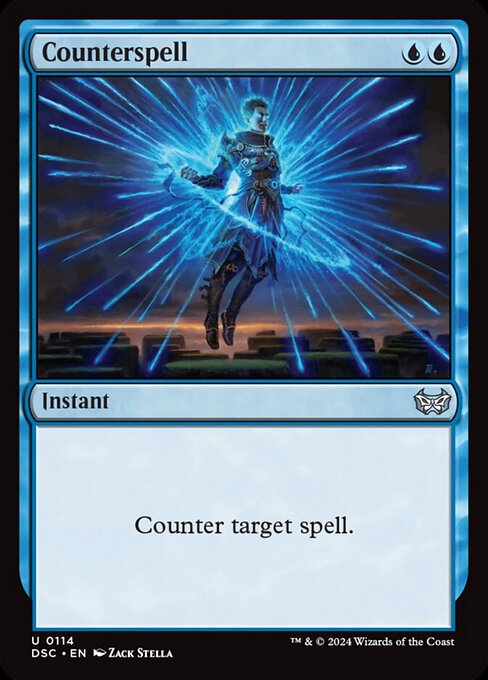
Counterspell
Baseline hard counter
The clean two-mana answer that gives blue decks a simple test for interaction quality. If a counter costs more than this, it needs a strong upside.
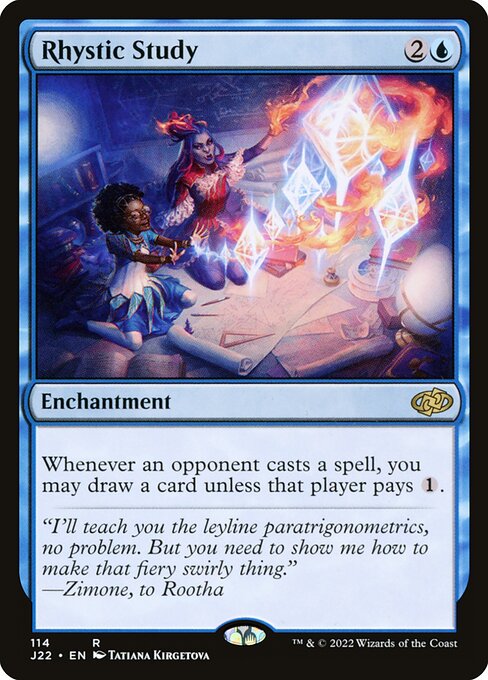
Rhystic Study
Repeatable card advantage
Punishes opponents for developing their boards and often draws several cards before the table can remove it.
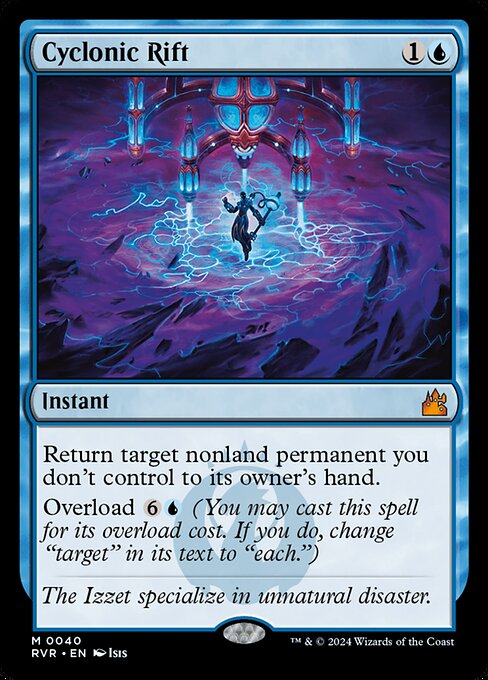
Cyclonic Rift
Reset button and finisher setup
A flexible bounce spell early and a one-sided overloaded reset later, especially strong when you can win before opponents rebuild.
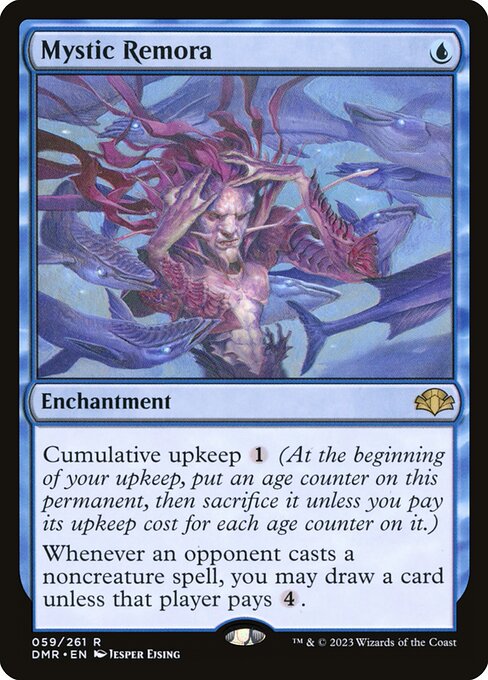
Mystic Remora
Explosive early draw
Excellent in spell-heavy pods and faster tables where opponents need to cast noncreature spells through its tax.
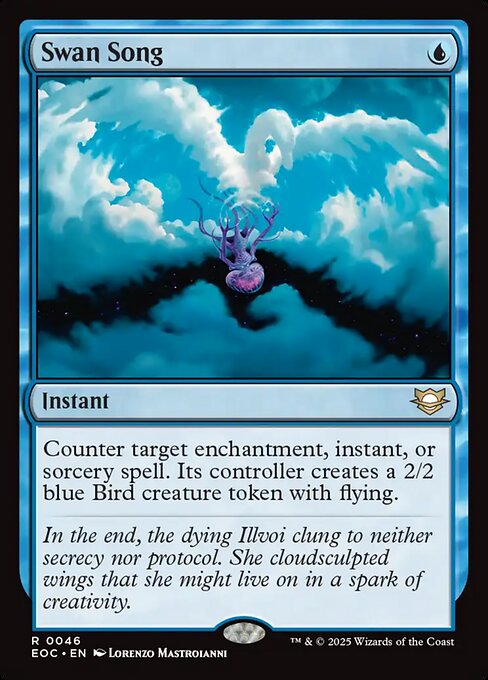
Swan Song
One-mana protection
Stops many of the spells that decide Commander games while leaving behind a token that is usually less important than the spell you countered.

Fact or Fiction
Instant-speed card advantage
A fair but powerful mid-power draw spell for decks that want to hold up interaction and make an end-step value play. Not as universal as Rhystic Study.
What makes a blue card a Commander staple?
A blue Commander staple is not simply a famous blue card. It is a card that solves a repeated multiplayer problem at a rate most decks can justify. Blue has three problems it answers better than any other color: finding the right card, interacting on the stack, and converting tempo into a winning turn. That is why the strongest blue staples usually fall into card selection, counterspells, bounce, theft, copy effects, draw engines, and combo-adjacent mana engines.
The important Commander question is not whether a staple is powerful. The question is whether it improves your specific 99. Counterspell is broadly useful because every table has spells worth stopping, but it is much worse in a greedy four-color mana base that cannot reliably make UU on turn two. Rhystic Study is strongest when it arrives early and the table must choose between slowing down or feeding you cards. Cyclonic Rift is strongest when your deck can turn the reset into lethal damage, a protected combo turn, or a commanding board position. If your deck cannot use that window, it is still good, but it may be less decisive than it looks.
Blue staples also change value by pod speed. In a lower-power table, expensive instant-speed draw can be excellent because games go long and players tap out. In a high-power table, one-mana interaction and compact card selection matter more because the critical turn may arrive before a seven-mana play is realistic. Use Deckcipher's Commander Deck Audit to check whether your list is leaning too hard on expensive blue cards when it actually needs cheaper answers.
Start with interaction: counters, bounce, and creature answers
Blue interaction should be built in layers. You want some cards that answer anything on the stack, some cards that trade up on mana, and some cards that handle permanents after they resolve. The common mistake is filling every interaction slot with counterspells, then losing to an early creature, an already resolved engine, or a commander that keeps coming back. A good blue deck does not only say no. It also buys time after something slips through.
Blue interaction package

Arcane Denial
Splashable counterspell
Easy to cast in multicolor decks and politically softer than many counters, but the extra cards matter if you cannot end the game soon.
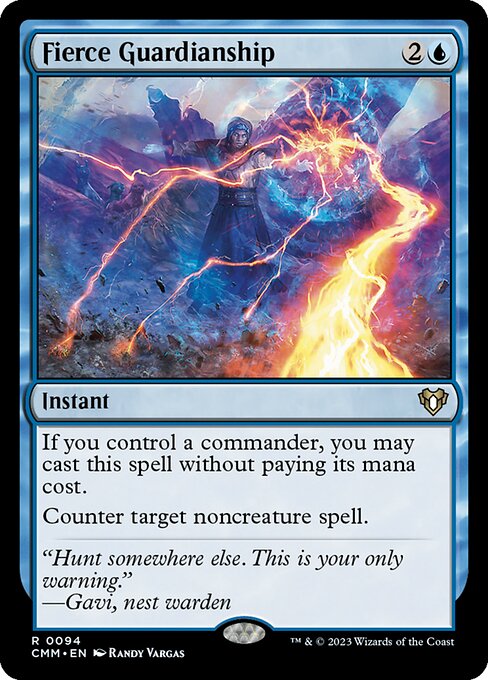
Fierce Guardianship
Free protection
Best in decks that reliably keep their commander on the battlefield and need to protect a key turn without spending mana.
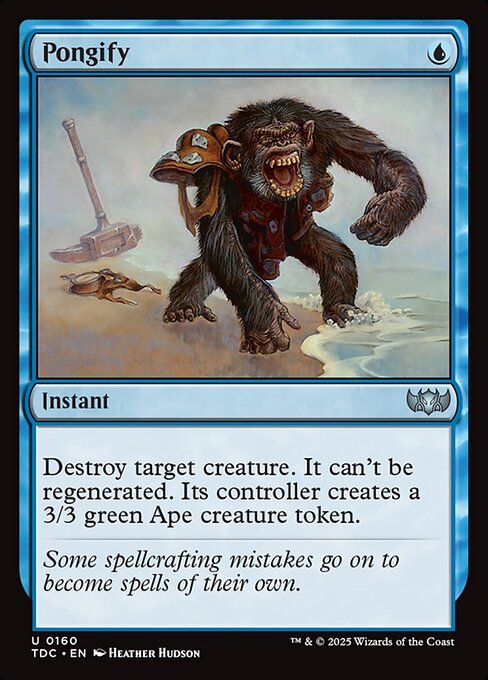
Pongify
Cheap creature removal
Turns a dangerous creature into a manageable body for one mana, which is often exactly what blue needs.

Rapid Hybridization
Redundant one-mana removal
Functions like a second copy of the one-mana blue creature answer in decks that need to respect opposing commanders.

Reality Shift
Exile removal
Costs more than the one-mana options but exiles, which matters against graveyard recursion and indestructible threats.
For most casual and mid-power blue decks, a reasonable starting point is 8 to 12 interactive cards, with at least 3 that can answer creatures or resolved permanents. A spellslinger deck may go higher because interaction triggers its commander or payoff cards. A creature-combo deck may go lower if it needs more bodies, but it still needs protection for the turn it tries to win. If your commander usually taps out on turn three, prefer easy-to-cast interaction like Arcane Denial, Swan Song, An Offer You Can't Refuse, or one-mana creature answers over holding up UU every turn in a shaky mana base.
Card draw and card selection are different jobs
Blue decks often blur card draw and card selection, but they do different work. Card draw increases your total resources. Card selection improves the quality of your next turns. Rhystic Study and Mystic Remora can bury the table in raw cards. Brainstorm, Ponder, and Preordain do not produce the same volume, but they help keep opening hands, hit land drops, find interaction, and assemble specific combinations of cards.
Selection and draw staples

Brainstorm
Instant-speed card selection
Best with shuffle effects, top-deck manipulation, or hands that need to hide and redraw specific cards. Weaker if your deck cannot clear bad cards from the top.
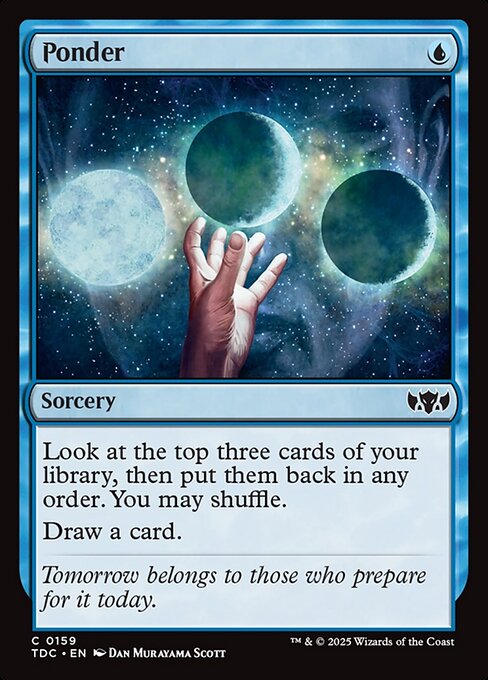
Ponder
One-mana setup spell
Excellent for smoothing early turns and deciding whether to keep or shuffle the top of your library.

Preordain
Reliable smoothing
Less explosive than the best shuffle setups but very consistent when your deck wants to filter draws without extra support.
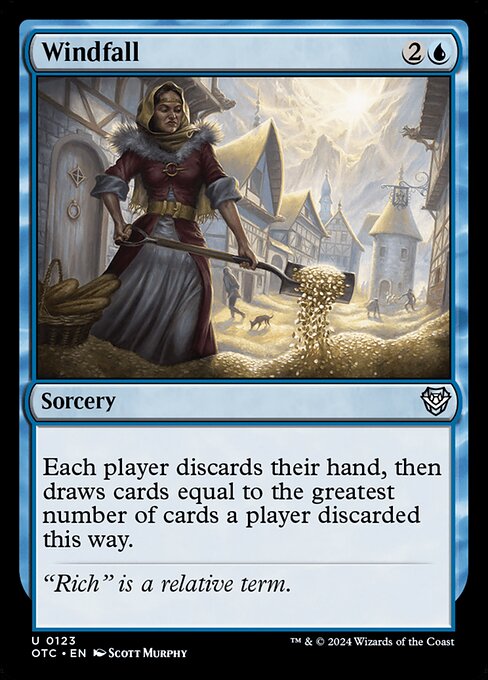
Windfall
Wheel and refill
Strong when your deck empties its hand quickly, punishes opponents holding sculpted hands, or uses graveyard and draw triggers. Dangerous if it refills opponents more than you.
The right mix depends on how your deck wins. A control deck that expects a long game can justify more repeatable draw and instant-speed refills. A combo deck wants cheap selection because finding a specific protection spell or missing piece matters more than drawing five random cards later. A tempo deck wants early smoothing because its first three turns determine whether it can deploy pressure and still hold up interaction.
Brainstorm becomes more attractive with a way to shuffle away the two cards you return, or a commander that uses the top of the library. There is no universal number of shuffle effects that makes it correct. Ponder includes an optional shuffle, while Preordain can move unwanted cards to the bottom without another card. In an opening hand that needs a land, those differences matter. A cantrip does not guarantee finding that land, and spending your only blue mana on selection also means you are not holding that mana for interaction.
How to decide between Rhystic Study and Mystic Remora
Rhystic Study and Mystic Remora are both iconic blue staples, but they ask different things from a game. Rhystic Study is the better long-game engine because it stays on the battlefield without cumulative upkeep and pressures every opponent's sequencing. Mystic Remora is the better early burst card in faster pods because it can draw multiple cards before opponents can afford to play around it.
Repeatable tax draw choice
Use this comparison when you have one premium draw slot or you are trying to decide which card better fits your pod.
Rhystic Study
Long-game tax engine
Best when games last long enough for repeated triggers and when opponents must keep casting spells into it.
Mystic Remora
Early burst draw
Best when the table is full of noncreature spells, fast mana, tutors, and early setup plays. The upkeep cost makes timing important.
Fact or Fiction
Fair instant-speed refill
Best when you want to keep mana open, avoid permanent-based draw engines, and make a strong end-step play in mid-power games.
In practical deck construction, do not ask which card is famous. Ask when you expect to cast it. If your first three turns are often tapped lands, ramp, and commander setup, Mystic Remora may sit awkwardly in hand because you cannot pay for it while developing. If your deck can cast it on turn one and still function, it can be one of the strongest starts available. Rhystic Study is slower but more forgiving, especially in decks that can protect it or profit from the extra cards over many turns. Fact or Fiction belongs below those two in raw power: it is excellent for draw-go control, but it is a fair four-mana value card, not a universal premium engine.
Cyclonic Rift is strongest when your deck has a follow-up
Cyclonic Rift is one of the most recognizable blue Commander staples because it changes the texture of a multiplayer game. Used early, it can remove a blocker, reset a threatening permanent, or protect you from a lethal attack. Overloaded later, it can remove every opposing nonland permanent and leave your board untouched. That is powerful, but it is not the same thing as winning.
Bad Rift scenario: you are at 12 life, overload Cyclonic Rift on your own main phase, attack one player for minor damage, and pass. Three opponents untap with full hands and replay mana rocks, commanders, and value engines. You spent seven mana to delay the game. Good Rift scenario: the Prosper player builds a lethal board, you overload Rift on the end step before your turn, untap with Talrand tokens and extra-turn mana, then kill the table or force through a combo with Swan Song backup. When the problem is only one commander or one graveyard engine, Reality Shift, Resculpt, Commit // Memory, or a targeted bounce spell may be a better use of mana than saving everything for Rift.
Mana engines and finishers: when blue stops playing fair
High Tide is a build-around burst of mana. It affects Islands for the rest of the turn, including opponents' Islands, and it needs enough Islands already on the battlefield plus a way to spend the extra blue mana. Count the resources in the actual turn rather than using a fixed deck-wide Island threshold. With four untapped Islands, casting High Tide from one leaves three Islands that can each make two mana, for six available afterward. Without High Tide, those four Islands could make four. The spell therefore adds two net mana in this example, and costs a card. Untap effects can change that result substantially.
Blue engines, payoffs, and example commanders
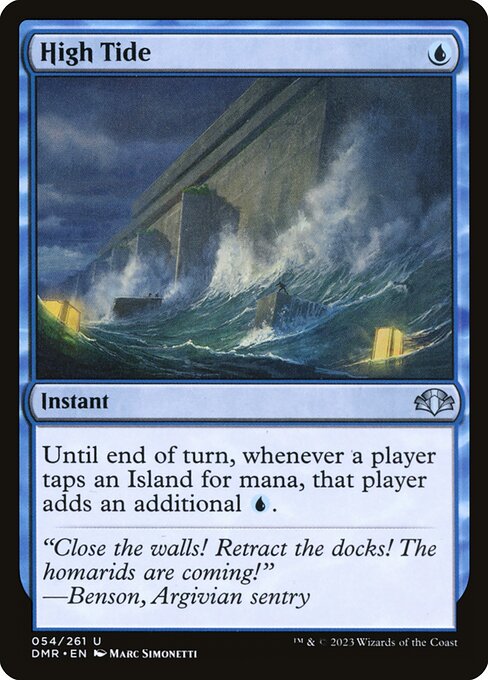
High Tide
Island-based mana engine
Excellent in mono-blue and Island-heavy decks that can convert a single explosive turn into a win or overwhelming advantage.

Mystic Sanctuary
Land-based recursion
Returns an instant or sorcery to the top when the Island count supports it, turning your mana base into late-game spell access.
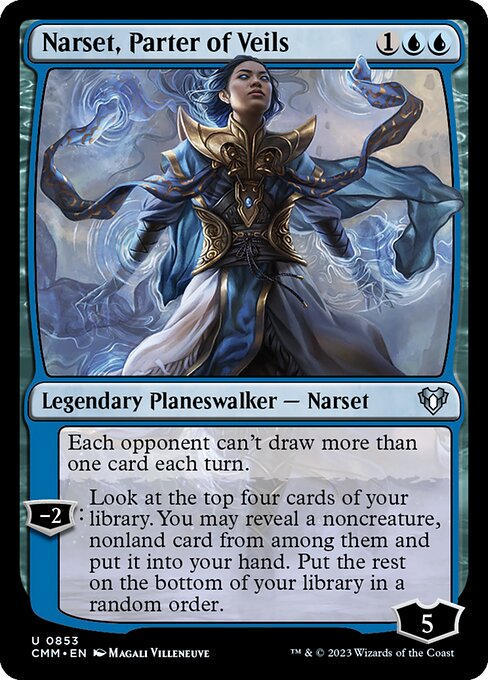
Narset, Parter of Veils
Card denial and selection
Finds noncreature spells and limits opposing extra draws. It is strongest when your deck is built to exploit the restriction responsibly.
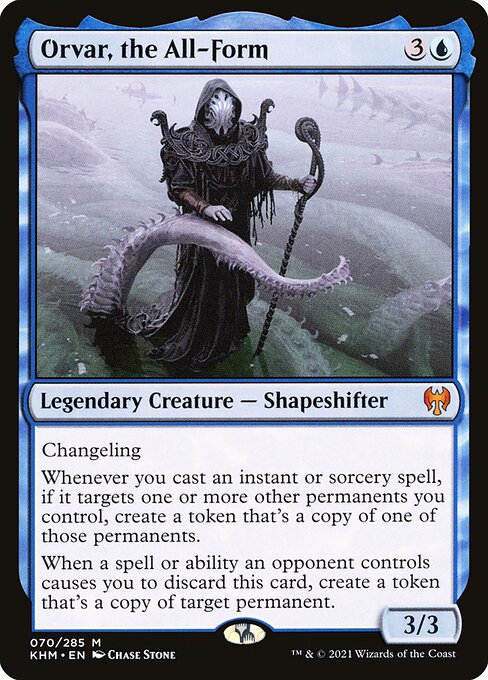
Orvar, the All-Form
Mono-blue copy commander
Rewards targeted spells and permanent copying, so cheap blue spells become engine pieces rather than simple cantrips.

Llawan, Cephalid Empress
Anti-blue commander option
A specialized commander for tables where blue creatures and blue mirrors matter, not a universal staple for every pod.
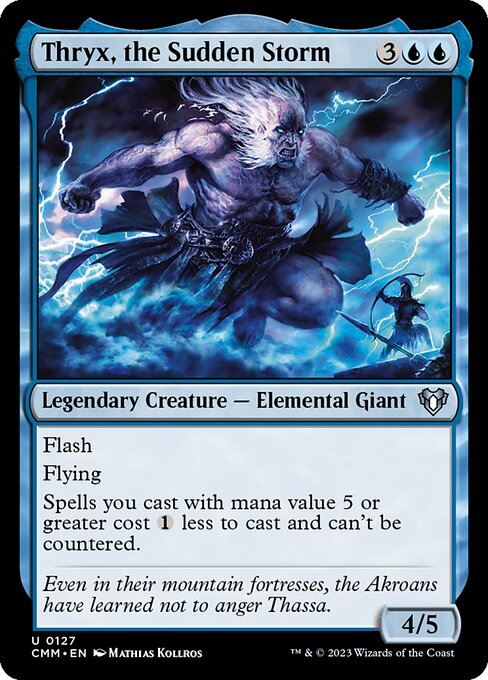
Thryx, the Sudden Storm
Big-spell commander
Supports expensive instant-speed plays and large spells, making mana planning more important than raw staple count.
Mystic Sanctuary has the Island subtype, but its own condition asks for three other Islands before it enters untapped. Its spell-return trigger also requires it to enter untapped. Fetching it earlier may fix mana but will not put a spell on top. Returning an instant or sorcery to the top is selection and delayed access rather than immediate card draw. Check whether your deck wants to replace its next natural draw with that card, and whether you can afford the Sanctuary entering tapped when the condition is unmet.
Narset, Parter of Veils limits opponents to one card drawn each turn. Pairing it with Windfall can leave opponents with very small hands, so treat that pairing as a deliberate disruptive plan. Windfall does not simply say that every player draws seven: it uses the greatest number of cards discarded this way. If an opponent has already drawn a card during that turn, Narset can stop that player drawing any more from Windfall. Hullbreacher is banned in Commander and is not an alternative for this package. Discuss draw denial before using it in a group expecting a slower resource game.
Blue staples in mono-blue and multicolor decks
Mono-blue decks can play more double-blue cards, more Island-count cards, and more color-intensive engines. A mono-blue Orvar, the All-Form list may want cheap spells that target its own permanents because those cards double as engine pieces. A big-spell Thryx, the Sudden Storm list may care less about one-mana cantrips and more about reaching the mana to cast large instant-speed threats while protected. Theft and copy cards also become more attractive in slower mono-blue decks: Phantasmal Image, Clever Impersonator, Sakashima's Student, Stolen Identity, and Gilded Drake-style effects can solve problems blue otherwise struggles to remove permanently, though they are meta calls rather than universal staples.
Multicolor decks must choose whether blue is their primary color or a support color. Counterspell needs two blue mana. Arcane Denial needs only one blue and one generic mana but compensates the controller of the countered spell with cards. Swan Song is easier to hold up but cannot target a creature, artifact, or planeswalker spell unless another listed type also applies. Count the actual early sources and intended turn before deciding which compromise fits. A single universal source target would hide differences between tapped lands, conditional rocks, and the land sequence your hand permits.
The more colors you add, the more you should audit color requirements instead of assuming every blue staple fits. Use the Mana Base Calculator to see whether you can actually cast your early blue interaction on time. A powerful hand with Counterspell is much worse if your first three lands cannot produce two blue mana.
A worked example for Talrand
Example 1: Talrand, Sky Summoner spellslinger. Suppose the deck has Cancel, Rewind, Opportunity, Flow of Ideas, Unsummon, and several five-mana token payoffs. Add Ponder, Preordain, Swan Song, Arcane Denial, Reality Shift, and Mystic Remora. Cut Cancel, Opportunity, one clunky five-mana payoff, a sorcery-speed draw spell, a narrow bounce-only answer, and an overcosted counter. Why: Talrand turns cheap spells into bodies, so a one-mana cantrip is not just smoothing; it is a token maker. The deck wants to cast Talrand, then protect him while continuing to trigger him. Counterspell is good here if the mana base is mono-blue, but free or one-mana protection becomes more important as the table gets faster.
Upgrade paths: what to add first
If you are upgrading a blue deck gradually, prioritize cards by the problem they solve. If you lose before stabilizing, upgrade cheap interaction first. If you run out of cards, upgrade repeatable draw. If your deck has strong cards but inconsistent openings, upgrade one-mana selection. If you often survive but fail to close, upgrade the cards that convert tempo into a win. Budget matters here: you do not need to buy every premium blue card before the deck functions.
Build your own blue staple package
The best blue Commander staples become much easier to choose once your list is visible as a whole. A card can be powerful and still be the wrong upgrade if your curve, color requirements, interaction mix, or win condition is already stretched. Build the deck first, then let the staple package support the plan.
Build your deck
Create a free Deckcipher account to save this Commander list and compare each change with the connected tools.
FAQ
What are the top blue staples for Commander?
The most broadly useful blue Commander staples are efficient interaction, reliable draw, and early selection: Counterspell or Arcane Denial, Swan Song, Pongify, Rapid Hybridization, Reality Shift, Rhystic Study, Mystic Remora, Cyclonic Rift, Ponder, Preordain, and Brainstorm when the deck has shuffle support. Context-dependent staples include Fact or Fiction, High Tide, Mystic Sanctuary, Windfall, and Narset, Parter of Veils.
Which blue cards are must-haves in EDH?
There are very few true must-haves because Commander decks vary so much. Counterspell is close to a universal baseline for blue interaction when your mana can cast it, while Rhystic Study and Cyclonic Rift are premium upgrades for many decks. Even those should be tested against your plan, budget, pod speed, and power expectations.
What blue staples should a competitive Commander deck consider?
Competitive-leaning blue decks usually prioritize free and one-mana interaction: Force of Will, Fierce Guardianship, Force of Negation, Pact of Negation, Flusterstorm, Mental Misstep, Swan Song, An Offer You Can't Refuse, and often Mana Drain. Mystic Remora and Rhystic Study remain strong because fast pods cast many noncreature spells. Counterspell is playable in some high-power lists but is not the same tier as free interaction in true cEDH. High Tide is a commander-specific engine, mainly for Island-heavy combo shells, not a generic cEDH staple.
How many counterspells should a blue Commander deck play?
Many casual and mid-power blue decks start around 5 to 8 counterspells as part of a larger 8 to 12 card interaction package. Decks that win at instant speed or need to protect a combo may play more. Creature-heavy or tap-out decks may play fewer and rely more on removal, bounce, and board development.
Is Cyclonic Rift always worth playing?
Cyclonic Rift is one of blue's strongest staples, but it is best when your deck can use the tempo swing immediately. If your deck overloads it and then passes without pressure, opponents may rebuild. It is strongest with a follow-up attack, combo turn, or decisive big-mana play.
Are Brainstorm, Ponder, and Preordain good in every blue deck?
Ponder and Preordain are broadly useful because they smooth early turns with little support. Brainstorm is more context-dependent because it improves when your deck has reliable shuffle effects or a concrete use for the top cards. They are strong, but they still occupy real deck slots.
When should I play Mystic Remora over Rhystic Study?
Mystic Remora is better when you expect early noncreature spells and can cast it before opponents develop. Rhystic Study is better when the game is likely to go longer and opponents must keep casting spells through the tax. Many blue decks can play both, but they are not identical.
What is the biggest mistake with blue Commander staples?
The biggest mistake is adding blue staples by reputation instead of role. A deck can have powerful cards and still lack creature answers, early plays, finishers, or reliable mana. Assign every staple a job, then cut the cards that do not help your commander execute its plan.
Turn the blue shortlist into actual cuts
| Problem in the list | Candidate change | What you give up |
|---|---|---|
| Three-mana unconditional counter feels slow | Cancel to Arcane Denial | The target spell's controller can receive cards |
| Too little access after holding mana open | An extra large threat to Fact or Fiction | A finisher slot becomes resource access |
| Only counters, few resolved-creature answers | A redundant counter to Reality Shift | A creature answer cannot stop an arbitrary spell |
Start the next blue revision with the turn your commander needs protection. Write down the spell you intend to cast, its blue pips, and the mana remaining for a counter. If the answer cannot be held up during that sequence, compare a cheaper answer before adding another expensive draw engine. Then inspect what happens when an opposing permanent resolves anyway: a bounce spell buys time, while a suitable lasting answer or a productive follow-up uses that time. Build your deck around those two windows and create a free account to save the list. Blue works best when permission, card access, and the commander can share a real turn.