
Quick answer
Black Commander staples are strongest when your deck can turn life, creatures, and graveyard cards into useful resources. Start with reliable card access and interaction, then choose recursion, tutors, or burst mana for a specific plan. Village Rites, Feed the Swarm, Reanimate, and Toxic Deluge solve different problems. None is a reason to ignore the rest of the deck.
Black staples start with a resource plan
Black can exchange life for cards, sacrifice creatures for value, and reuse the graveyard. Those abilities are powerful because Commander gives players time and resources to build engines, but the costs remain real. Paying life into a crowded combat board can put you within reach of attackers. Sacrificing your only useful creature can leave you without a commander engine. Returning an expensive creature may expose a large investment to a cheap exile spell.
Choose which resource your commander actually supplies. A deck that makes expendable tokens can use sacrifice draw. A deck that already draws cards might need more mana and interaction. A reanimator deck can prioritize discard and ways to put creatures into the graveyard, while a mono-black control deck may prefer unconditional card access that works without creatures. Calling all of these cards staples does not make them interchangeable.
Black also changes when it is part of a multicolor deck. Feed the Swarm covers a significant mono-black weakness, but a deck with white or green can compare more flexible enchantment answers. A black tutor might find a specific synergy piece, yet another color may provide a creature tutor that fits the same task better. Build the whole list around its plan, then decide what black needs to contribute.
A role-based black shortlist

Night's Whisper
Unconditional draw
Two cards for two mana and two life. It works with an empty battlefield, unlike sacrifice draw.
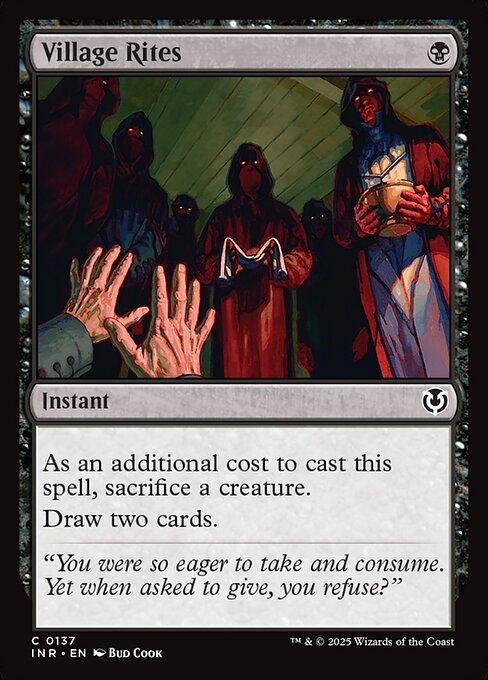
Village Rites
Sacrifice draw
Trades a creature and the spell for two cards at instant speed. Best when the sacrificed creature has already done its job.
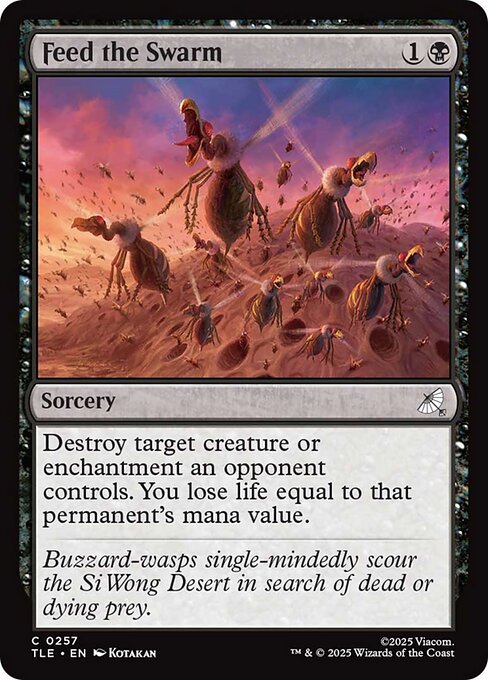
Feed the Swarm
Enchantment coverage
Destroys an opposing creature or enchantment at sorcery speed, with life loss based on its mana value.

Toxic Deluge
Creature reset
Pays life to give all creatures a toughness reduction for the turn. It can handle indestructible but still affects your board.
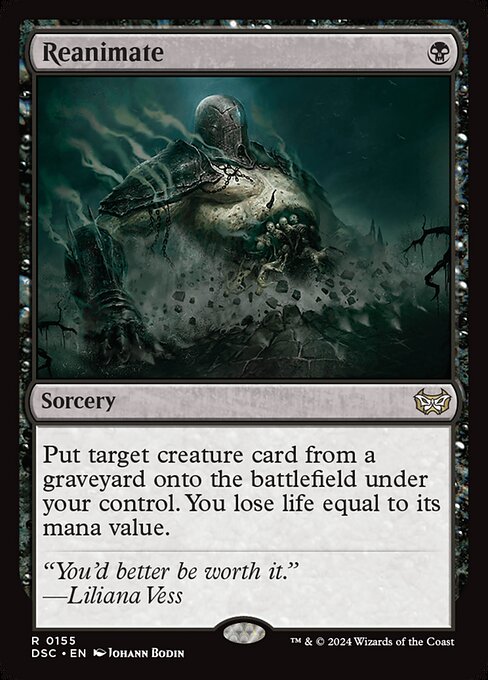
Reanimate
Graveyard access
Returns a creature from a graveyard and costs life equal to its mana value. The target and the life budget both matter.

Victimize
Creature recovery
Requires a creature to sacrifice on resolution and returns two targeted creature cards from your graveyard tapped.
Use simple draw when you cannot guarantee fodder
Night's Whisper and Sign in Blood are useful reference points for card access. They do not need a creature or a stocked graveyard. Sign in Blood requires two black mana and targets a player, while Night's Whisper has a single black pip and affects you. A multicolor list with an early black splash should account for that difference rather than assuming both are equally easy to cast. Neither provides an ongoing engine, but both can help recover from an empty board.
Village Rites and Deadly Dispute ask for a sacrifice as an additional cost. If the spell is countered, the sacrificed permanent does not come back. You also cannot respond after an opponent has already paid that cost by removing the sacrificed creature. Dispute can use an artifact or creature and creates a Treasure as part of resolving. It is especially useful with expendable tokens, but giving up an important permanent just to draw two can leave you behind.
Skullclamp is another candidate in a token deck, even though it is colorless. Compare its repeated draw potential with the equip cost and the need for creatures to die. A commander that makes one fragile token each turn may support it well. A creature-light black deck may instead want a draw spell that functions immediately. Counting every sacrifice spell as generic draw can make the list look well supplied while its actual opening hands lack anything it can sacrifice.
Engines must repay their life and mana costs
Phyrexian Arena supplies an extra card at your upkeep and costs life each time. It is slower than drawing several cards immediately, and an Arena cast late may not produce enough cards before the game ends. Black Market Connections triggers at the beginning of your first main phase and offers several resource modes. The chosen modes cause their stated life losses during resolution rather than asking for life-payment costs. Selecting every option can therefore leave you with a much lower life total. Choose the options you can use rather than treating every available resource as free.
Necropotence is a different kind of engine. It skips your draw step and uses life to exile cards that a delayed trigger puts into your hand at the beginning of your next end step. Its discard clause can exile cards that you discard, which matters for a graveyard strategy. It does not simply draw the cards immediately. Check both the timing and your ability to survive until the cards arrive before exchanging a large portion of your life.
Bolas's Citadel lets you play lands and cast spells from the top using its permission and alternative cost, with normal timing and land-play restrictions still applying unless something else changes them. A land can stop a chain if you have no land play available. High mana values can cost a dangerous amount of life. It is a build-around engine that rewards a suitable curve and ways to move the top card, not a universal substitute for card draw.
Mix creature removal with an answer to enchantments
Go for the Throat destroys a nonartifact creature. Infernal Grasp destroys a creature without that artifact restriction but costs life. Baleful Mastery can exile a creature or planeswalker and offers an alternative cost with an opponent-draw drawback. Choose the coverage your games demand. If a problem commander is indestructible or easily reanimated, a destroy spell may not solve the repeated issue even when it is efficient.
Feed the Swarm is important because it can destroy an enchantment an opponent controls, a job black traditionally has fewer simple ways to handle. It is a sorcery and its life loss depends on the target's mana value. Withering Torment offers an instant-speed creature-or-enchantment answer with a fixed life cost. Compare the actual speed and mana available in your deck rather than treating any card that names enchantment as an automatic inclusion.
A sacrifice effect can bypass targeting restrictions when it targets a player rather than the creature, but an opponent may choose their least important creature. Those effects work best when the board makes that choice difficult or when your deck repeats them. Do not call a sacrifice spell unconditional removal for a specific threat if the opponent has three disposable tokens. The text may avoid hexproof and still fail the strategic job you need.
Choose a sweeper with a recovery plan
Toxic Deluge gives all creatures minus X power and toughness until the end of the turn, with X chosen through the life payment. Indestructible does not prevent a creature from dying because its toughness is zero or less. Deluge still reduces your own creatures, and the life payment can matter if you are already under pressure. Use the smallest X that answers the required threats unless there is a reason to clear more of the board.
Damnation is a straightforward creature destruction spell with a regeneration restriction. It cannot remove indestructible creatures just by destroying them. Living Death is more complicated: it exiles creature cards from graveyards, sacrifices creatures on the battlefield, then puts the previously exiled cards onto the battlefield. It can be a powerful reset and reanimation turn, but it helps opponents with stocked graveyards as well. Exiling an opposing graveyard first can change the result substantially.
Do not choose a wipe solely because your commander has black in its identity. An aristocrats deck might profit from its creatures dying, while a reanimator deck might want to preserve a single expensive target. A list that relies on several small utility creatures can lose its entire engine to the same reset it uses defensively. Decide what you expect to retain, recover, or deploy afterward, and ensure that plan is present in the deck.
Reanimation needs targets and a way to reach them
Reanimate can use a creature card from any graveyard, but it still targets and still costs life equal to the creature's mana value. Animating an opponent's large creature may be an excellent line or an unaffordable one at low life. Animate Dead costs more mana and uses an Aura with its own restrictions and leave-the-battlefield relationship. Removing that Aura can cause the returned creature to be sacrificed. Read the complete text rather than treating every reanimation spell as a permanent ownership change.
Victimize targets two creature cards in your graveyard, then asks you to sacrifice a creature as it resolves. You need a creature available at that point. The sacrificed creature cannot be one of the targets because targets were chosen while casting the spell. The two returned creatures enter tapped, which can matter for blocking and abilities that require tapping. A list that rarely controls disposable creatures should not assume Victimize always works for its printed mana cost.
A reanimation package also needs ways to stock the graveyard. Discard outlets, self-mill, and sacrifice can all help, but each has a separate deckbuilding cost. Adding several expensive creatures and several reanimation spells without enough setup can produce hands full of mismatched halves. Keep some creatures you can reasonably cast and some card access that works when graveyards are unavailable. Graveyard hate is an ordinary part of Commander, not an exceptional event to ignore.
Tutors should find a plan you intend to repeat
Demonic Tutor finds a card and puts it into your hand. Diabolic Intent does the same kind of search but requires a creature sacrifice as an additional cost. Vampiric Tutor places the selected card on top and costs life, so using it without an immediate draw changes your next draw rather than adding a card directly to hand. These differences affect both the tempo of your turn and whether the deck can recover after an opponent interrupts it.
Before adding a tutor, write down what you expect to find. A flexible answer, a land needed to function, and a compact combo piece create different game patterns. If you repeatedly search for the same deterministic finish, the deck will behave more consistently even when the other cards remain unchanged. That can be intentional, but it deserves a clear pregame explanation. A tutor is not merely an expensive card-quality improvement with no effect on how the deck plays.
You can build a strong black deck without a universal tutor suite. Extra draw preserves variety and may be more useful when you need several resources rather than one exact card. A narrow creature tutor can support a toolbox without finding every possible finish. Choose the degree of consistency you want, and reserve enough slots for the actual enablers, interaction, and win condition. Tutors cannot fix a package that has no coherent destination.
Distinguish permanent mana from a burst
Dark Ritual converts one black mana and a card into three black mana once. It is useful when that burst enables an important commander or engine ahead of schedule. It does not increase the resources available on each following turn. A slow value deck can run out of cards after a dramatic opening if the accelerated play does not repay the investment. Compare that line with an ordinary two-mana rock or another land drop before deciding the ritual is an automatic upgrade.
Cabal Coffers uses an activation cost and counts Swamps you control. It does not simply tap for the number of lands in the deck. Urborg, Tomb of Yawgmoth makes lands into Swamps in addition to their other types, which can improve Coffers but also changes opponents' lands. A mana base with few Swamps and no reliable access to the pairing may prefer a source that functions independently. Test Coffers in a realistic early hand, including the two mana needed to activate it.
Crypt Ghast adds one extra black mana whenever you tap a Swamp for mana and has extort. It does not generally double that land's output: a Swamp that produces several mana still creates only one extra black from this trigger. Its extort reminder text does not add white to its color identity. The creature is vulnerable, so a hand that assumes it survives indefinitely needs a fallback. Big mana should lead to a useful payoff, whether that is repeated commander casts, a scalable spell, or several resources in the same turn. Extra mana without card access is only part of the plan.
Aristocrats cards need outlets, fodder, and payoffs
Viscera Seer offers a repeatable sacrifice outlet for creatures and provides scry rather than card draw. Blood Artist and Zulaport Cutthroat reward deaths in different ways: Artist targets a player and can see other players' creatures die, while Cutthroat focuses on your creatures and drains each opponent. A sacrifice deck benefits from knowing those distinctions when facing tokens, targeting restrictions, and multiplayer life totals.
A pile of death payoffs is not an engine if there is no way to create expendable creatures or sacrifice them. Likewise, several outlets with no payoff may remove your own board without advancing toward a win. Build the package as connected parts. Include recovery and a route to close the game, but do not claim that any two death-themed cards create an infinite loop. A loop needs a verified resource balance and a repeatable sequence.
| Current problem | Candidate comparison | Tradeoff |
|---|---|---|
| Draw spells lack sacrifice material | Village Rites to Night's Whisper | Reliable access loses the instant-speed sacrifice utility |
| Creature destruction misses enchantments | A redundant creature answer to Feed the Swarm | Sorcery speed and life cost |
| Expensive creatures are stranded in hand | An extra large threat to a setup or draw spell | Less top-end power, fewer mismatched hands |
| Many death payoffs, no outlet | A redundant payoff to Viscera Seer | Scry improves selection but does not draw cards |
Frequently asked questions about black staples
Build your deck
Create a free Deckcipher account to save this Commander list and compare each change with the connected tools.
FAQ
Is Feed the Swarm mandatory in every black deck?
No. It is a valuable enchantment answer for mono-black and some other color combinations, but your other colors may offer better speed or coverage. Compare it with the actual gap in your interaction package. It also costs life and cannot be held up at instant speed.
Is paying life basically free in Commander?
No. The format starts with a large life total, but combat and repeated payments can consume it quickly. Consider when the resources arrive and whether they let you stabilize or win. Paying a large amount into a board that can attack you before the next turn is a meaningful risk.
Does Necropotence draw cards immediately?
No. Its activated ability exiles the top card face down and creates delayed access at the beginning of your next end step. It also skips your draw step and has a discard-related exile ability. Those details matter for timing, hand size, and graveyard plans.
Can Victimize return the creature I sacrifice for it?
Not as one of that spell's two targets. You choose the two target creature cards in your graveyard while casting, and the sacrifice happens later as the spell resolves. The creature sacrificed at that later point was not already a chosen graveyard target.
Does Toxic Deluge beat indestructible?
It can. Indestructible stops destruction and lethal-damage destruction, but does not keep a creature with zero or less toughness on the battlefield. Deluge must reduce toughness enough to matter, and you must be able to pay the life. It also affects your own creatures.
What should I upgrade first in a black deck?
Choose the missing role. Reliable draw helps a deck that stalls without creatures. Cheap interaction helps a deck that loses with expensive answers in hand. A reanimator deck may need setup rather than another large target. Fix that bottleneck before adding tutors or premium engines.
Build a black package that can recover
Review the list with the Interaction Checker, then inspect its actual mana in the Mana Base Calculator. Mark which draw spells require sacrifice material, which recursion cards need a target, and which mana sources need another card. The point is to catch a hidden dependency before it appears in an opening hand, not to make every card equally generic.
Build your deck around that resource plan and create a free account to save it. Keep room for interaction, a recoverable engine, and a finish that the rest of the deck supports. Black rewards careful exchanges. The right staple package gives you something useful to exchange, a reason to exchange it, and a way to keep playing when an opponent breaks the engine.