
Quick answer
A Background is a separately cast enchantment that shapes your commander’s job. Choose its colors and support needs early, then plan the turns before both commander cards are established.
Choose a Background is a specific pairing permission
A commander with choose a Background can pair with a legendary Background enchantment as a second commander. The permission does not allow an arbitrary enchantment, and a legendary Background cannot normally be designated as your sole commander. It is one specific way to build with two commanders, with its own requirements before the game begins.
Wilson, Refined Grizzly can lead alongside Raised by Giants because Wilson has the required ability and Raised by Giants is a legendary Background enchantment. An unrelated creature with ordinary partner cannot use Wilson's permission without being an eligible Background. The ability does not create a three-card command zone.
Choose the creature and Background together before assembling the list. The enchantment determines more than a flavor label: it can change the colors available and the role your creature is expected to play. Confirm the actual pairing instead of assuming every legendary enchantment fits.
The enchantment needs to be on the battlefield to work
A Background beginning in the command zone is available to cast, but its ordinary static abilities do not automatically affect the battlefield from that zone. You must cast and resolve it, paying its own cost. The creature commander and Background are separate cards, not one combined spell that enters for a single payment.
Casting Wilson for one generic and one green gives you Wilson's printed body and abilities. Raised by Giants remains in the command zone until you cast it separately for five generic and one green. Wilson does not become 10/10 merely because that Background was selected during deck construction.
This timing gap is central to evaluating the pair. A cheap commander with an expensive Background may spend several turns operating without its intended enhancement. Choose enough early support that the deck can develop while the enchantment is still waiting for its own casting window.
Two commanders share colors but keep separate histories
The pair's combined color identities establish the deck's allowed colors. Its total remains exactly 100 cards, normally leaving 98 supporting cards. Each commander has its own command-zone cast history and tax. Casting the creature repeatedly does not increase the Background's tax, and casting the Background does not increase the creature's tax.
Wilson with Raised by Giants remains mono-green. Wilson with Folk Hero instead adds white to the deck's available identity, while Wilson with Cultist of the Absolute adds black. These are different legal card pools even though the same creature begins the construction. Colorless mana production cannot substitute for including a required color in the identity.
Track the cast history on each commander card and rebuild the mana base when changing the Background's color. The <a href="/blog/partner-in-commander-rules-and-deckbuilding/">partner guide</a> covers the common two-commander bookkeeping without making the different pairing permissions interchangeable.
A Background can be an ordinary main-deck card
Background is an enchantment subtype, and a legal Background can be included in the main deck when its color identity fits. It does not need to be designated as a commander for its ordinary battlefield text to function. Conversely, putting one in the 98 does not make it available in the command zone or grant it commander status.
A legal deck with two ordinary partner commanders can include a Background in the supporting list. If its text affects commander creatures you own, it can affect the applicable commander creatures when it is on the battlefield. It is still one of the supporting cards and not a third commander.
A creature with choose a Background can also be used without designating a second commander. That choice gives up the second command-zone resource and its color contribution, but does not make the creature's other printed abilities disappear. Evaluate the actual configuration rather than assuming the permission must always be used.
Read commander creatures you own literally
Many Backgrounds modify commander creatures you own. That wording does not mean every legendary creature, every creature you control, or every permanent in the command zone. A commander designation is a property of the selected card. A normal legendary creature in the main deck does not become a commander merely because it resembles the deck's leader.
Raised by Giants can change the base size of your actual commander creature while leaving an unrelated legendary support creature unchanged. If your two creature commanders are both on the battlefield and satisfy the wording, a main-deck Background can affect both. A Background enchantment that is not a creature does not receive a commander-creature bonus merely from being your second commander.
Distinguish ownership from control if theft effects appear. The exact words on the Background determine which commander creatures receive its effect. You do not need to solve every possible control-changing interaction during deck construction, but you should avoid casually replacing own with control in a rules explanation.
Raised by Giants sets a base rather than a final size
Raised by Giants sets the base power and toughness of applicable commander creatures to 10/10 and adds Giant to their creature types. Other counters and applicable modifiers can still change the resulting size. It does not erase all abilities, remove every existing creature type, or guarantee the final displayed creature is exactly 10/10.
Wilson with Raised by Giants and two +1/+1 counters is normally 12/12 before other effects. Wilson retains reach, vigilance, trample, and ward two from its own text. The Background does not itself grant haste, so a newly cast Wilson still needs the usual permission to attack immediately.
If Raised by Giants leaves, its continuous effect stops applying. Wilson's counters remain when nothing else removes them, but the base-setting effect is gone. Compare that vulnerability with an enhancement that places counters once and leaves a lasting result after its source disappears.
Granted abilities belong to the creature that receives them
Some Backgrounds say commander creatures have a quoted triggered ability. The resulting ability is on the creature, rather than being a trigger located only on the Background. Read its trigger event and controller from that source. Removing the Background prevents future grants, but an ability that already triggered can normally remain on the stack.
Folk Hero gives a qualifying commander creature a cast trigger for a spell sharing a creature type with that creature. With Wilson, Bear is one relevant type. The ordinary Wilson creature does not suddenly reward every creature spell simply because Folk Hero is present; the shared-type condition still needs to be met.
Changes to a creature's types can change which later spells qualify. That makes type support a real package decision. Build enough appropriate spells to justify the Background instead of counting every creature in the list as an automatic draw source.
Once each turn and intervening conditions change the payoff
Folk Hero's granted ability triggers only once each turn. That limit belongs to the actual ability and prevents a second qualifying spell in the same turn from automatically yielding a second draw through that same instance. A relevant instant-speed play on another player's turn can be a separate opportunity, but the list needs a legal way to cast it then.
Cloakwood Hermit instead grants an end-step trigger conditional on a creature card entering your graveyard from anywhere during that turn. Milling or discarding a creature card can qualify; creating and sacrificing only a creature token does not put a creature card into the graveyard. The ability makes two tapped Squirrels when its condition is satisfied.
These conditions point toward different support. Folk Hero wants appropriate casts distributed across turns, while Hermit wants creature cards reaching your graveyard and can provide bodies without another spell cast. Do not compare them using an unexplained promise of one extra resource every turn.
Master Chef changes entries instead of adding counters later
Master Chef grants abilities that make a commander creature enter with an additional +1/+1 counter and make other creatures you control enter with an additional counter. These are modifications to how the creature enters. They are not ordinary triggers that wait on the stack while the new creature sits without the additional counter.
With a single commander creature and Master Chef established, a later ordinary creature can enter with the extra counter. Casting Master Chef after that creature is already present does not retroactively add one. Likewise, an old commander already on the battlefield does not receive its own entry counter merely because the Background subsequently resolved.
A counter deck can value this timing because the incoming creature is already larger when entry conditions are evaluated. The source still needs to provide the appropriate effect at the relevant moment. Compare this with a later triggered counter placement rather than treating every counter engine as mechanically identical.
Cultist’s low cost includes a recurring obligation
Cultist of the Absolute gives applicable commander creatures +3/+3, flying, deathtouch, ward requiring three life, and an upkeep ability that sacrifices a creature. The ward payment is life, not three mana. Its combat package is substantial, but the upkeep obligation asks for a renewable supply of creatures or a willingness to sacrifice something important.
With Wilson and Cultist, Wilson's own ward two and the granted ward payment are separate triggered abilities when an opposing spell or ability targets it. The opponent may need to handle both to keep the targeting effect from being countered. This does not stop untargeted sweepers or effects that do not trigger ward.
The sacrifice instruction can require sacrificing the commander itself if no other appropriate creature is available. Budget for that upkeep before describing a one-mana enchantment as pure upside. Cheap setup can be efficient while still imposing a real cost on future turns and the deck's creature allocation.
Cards worth comparing before you choose a package
Examples and the jobs they do
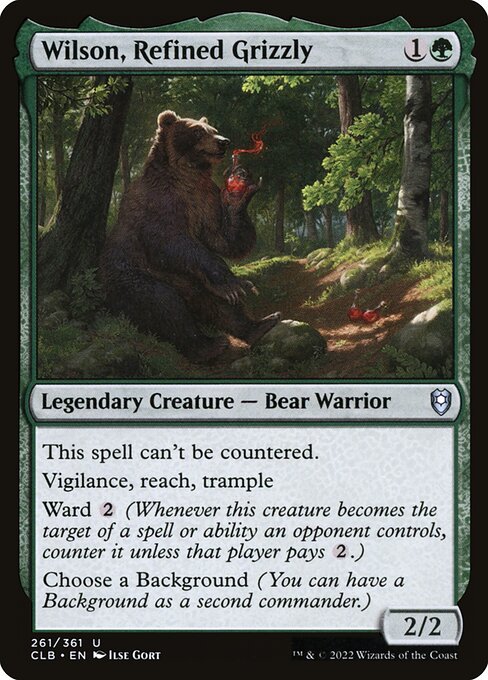
Wilson, Refined Grizzly
A capable inexpensive base creature
Wilson supplies reach, vigilance, trample, ward two, and a spell that cannot be countered.

Raised by Giants
Base-size transformation
Raised sets applicable commander creatures to a 10/10 base and adds Giant.

Cloakwood Hermit
Graveyard-event token production
Hermit grants an end-step ability producing two tapped Squirrels after a creature card reached your graveyard that turn.

Cultist of the Absolute
Combat tools with an upkeep payment
Cultist adds size, flying, deathtouch, and life-based ward.

Folk Hero
Type-based cast access
Folk Hero grants a once-each-turn draw trigger for shared creature types.

Master Chef
Counters as creatures enter
Chef gives the commander an additional entry counter and adds a counter to other creature entries through its granted ability.
Wilson, Refined Grizzly
Its choose-a-Background permission lets the enchantment define a second layer of the plan. The protection and combat abilities are already on Wilson before the Background resolves. Uncounterable does not mean immune to every way a spell can leave the stack. Ward also does not prevent an opponent from targeting; it creates a separate tax trigger after qualifying targeting happens.
Raised by Giants
It does not replace other abilities or counters. A commander enhanced this way can pressure the separate commander-damage threshold if combat damage connects. Its six-mana cost creates a development question. The deck needs enough mana and enough protection of the actual attack to turn the large base into a useful result.
Cloakwood Hermit
From anywhere includes suitable milling and discard events as well as a nontoken creature dying. Tapped Squirrels cannot normally serve as fresh blockers immediately. They can become later combat resources or future sacrifice material, but the timing matters if your board is already under pressure.
Cultist of the Absolute
The granted upkeep ability requires a creature sacrifice, so the deck needs renewable material. A Background remains a separate permanent an opponent may answer. An untargeted sweeper can bypass ward, and a sacrifice is not prevented by indestructible. Include recovery and creature supply rather than treating the visible defensive keywords as complete protection.
Folk Hero
A commander with several types can offer several kinds of qualifying spell, but the same granted ability still has its stated frequency limit. A creature entering without being cast does not meet a cast event. Check whether the deck's blink, reanimation, or token package actually helps this particular Background before counting it toward the draw plan.
Master Chef
It asks for creatures entering after the relevant effects are established, rather than distributing counters to an existing board. The choice fits a different sequence from a six-mana base setter. An earlier counter engine can build several bodies over time, while a late Background may leave the existing creatures unchanged.
Practice Wilson with two different Background plans
With Wilson and Raised by Giants selected, cast Wilson on turn two if your mana supports it. The creature is still its ordinary printed size while Raised waits in the command zone. Later resolving Raised changes the base to 10/10. Two +1/+1 counters would normally make the result 12/12, while Wilson retains its own combat abilities.
Now imagine Raised is removed before combat. Wilson does not keep the 10/10 base merely because it applied earlier. Its counters can remain, and its printed abilities remain, but you must evaluate combat using the current characteristics. A protection spell or a different attack can be more useful than insisting on the original damage plan.
A Wilson and Cultist configuration instead gets its enhancement earlier and adds black to the legal identity. It asks for a creature sacrifice on later upkeeps, so a hand with no renewable bodies may have a different weakness. These are concrete costs of the selected enchantment, not interchangeable labels for the same Bear deck.
Build both legal versions in <a href="/deck-builder?guest=1">Deckcipher's deck builder</a> and create an account to save them. Compare the actual curve, colored sources, creature supply, and available recovery. Use the <a href="/blog/how-to-build-a-commander-mana-base/">mana-base guide</a> when a new Background adds another color.
A decision table for the interaction
| Position | Correct result | What to check |
|---|---|---|
| Background in command zone | Available to cast | Ordinary battlefield effects not active yet |
| Background in supporting list | Can function after resolving | Does not become a third commander |
| Raised plus two counters | Normally 12/12 base-adjusted result | Counters remain separate modifiers |
| Cultist upkeep with no spare creature | Sacrifice still required | Indestructible does not prevent sacrifice |
Frequently asked questions
Build your deck
Put these choices into a Commander list. Create a free account to save your deck and keep tuning it with Deckcipher.
FAQ
Is the Background active from the command zone?
Its ordinary enchantment abilities normally are not. You must cast and resolve it onto the battlefield. Choosing it as a second commander gives access and a color-identity contribution, not a free continuous battlefield effect before paying its cost.
Does the Background use the creature’s commander tax?
No. Each commander tracks its own casts from the command zone. Recasting Wilson does not increase the Background's tax, and recasting the Background does not increase Wilson's. Pay for each card separately when casting it.
Can any legendary creature choose a Background?
No. Designating the enchantment as a second commander needs the choose-a-Background permission and an eligible legendary Background. An ordinary legendary creature or ordinary partner does not gain that permission from theme or matching colors.
Can I put a Background in the main deck?
Yes, when it otherwise fits the deck's rules and color identity. Its battlefield abilities can function there. It remains a supporting card, does not begin in the command zone, and does not become a third commander.
Does Raised by Giants remove counters?
No. It sets the relevant base power and toughness, while counters and other applicable modifiers can still affect the final size. Its effect stops when the enchantment leaves, but counters do not automatically disappear with it.
Does Folk Hero reward every creature entering?
No. Its granted ability cares about casting a spell sharing a creature type with that commander creature and triggers only once each turn. Entry through reanimation or token creation is not automatically a qualifying cast.
Does Master Chef grow creatures already present?
Not merely because the Background resolves. Its relevant abilities modify creature entries. Establish it before the entry you want to enhance, and do not add retroactive counters to creatures that were already on the battlefield.
Can I ignore Cultist’s sacrifice with indestructible?
No. Sacrificing is different from destroying. The granted upkeep ability still requires the sacrifice when it resolves, and the commander may be the available creature if no other suitable body remains. Plan token supply and recovery accordingly.