
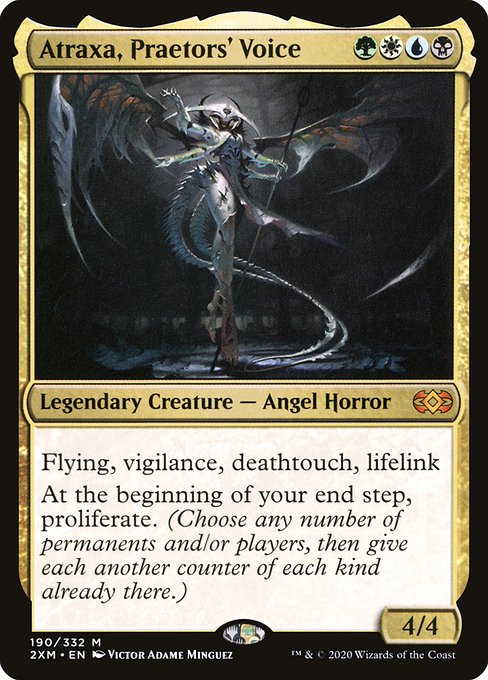
The best Atraxa, Praetors' Voice upgrades depend on which Atraxa deck you are building. +1/+1 counters wants cheap creatures and counter payoffs. Poison wants efficient toxic or infect threats and proliferate. Superfriends wants planeswalker protection, ramp, and repeated proliferate. Do not upgrade Atraxa by adding every powerful card with a counter on it. Pick one main plan, fix the mana, add reliable card draw, and make every proliferate trigger matter. This guide covers Atraxa, Praetors' Voice specifically, not Atraxa, Grand Unifier, since the two commanders build in completely different directions.
Audit your Atraxa deck before you buy more staples
Run your Atraxa list through the Deckcipher audit to see mana, ramp, draw, interaction, and bracket pressure side by side.
Pick one Atraxa lane before you upgrade anything
Atraxa proliferates every end step, but she does not create most counter types herself, and she supports too many possible themes at once. The biggest mistake in Atraxa deckbuilding is mixing every counter card into one expensive, unfocused pile. Choose one main lane, +1/+1 counters, poison, superfriends, or general proliferate value, then build the mana, draw, and protection around that specific plan.
Why Atraxa, Praetors' Voice is powerful
Atraxa is a five-mana flying, vigilance, deathtouch, lifelink body that is already hard to attack into or race, and her end step trigger proliferates, adding another counter of each kind already present among permanents and players you choose. That is a genuinely powerful passive ability, but it is important to understand what it does not do: Atraxa does not create +1/+1 counters, poison counters, or loyalty counters by herself. She only grows counters that are already on the battlefield or on a player. That means the deck's actual power comes from the enablers you build around her, not from Atraxa's card text alone.
This is also why Atraxa decks earn a reputation for feeling unfocused. Four colors and a proliferate trigger technically support +1/+1 counters, poison, planeswalkers, sagas, and any other counter-based mechanic at once, which tempts players into jamming one of every good counter card instead of building a coherent deck. A focused Atraxa deck with one clear plan will consistently outperform an unfocused pile of powerful cards that do not support each other.
How Atraxa actually wins depends entirely on the lane you pick, but the win conditions themselves are usually simple once the support is in place: a wide, pumped creature board swings for lethal combat damage, a single evasive infect or toxic threat closes the game at ten poison counters well before anyone is close to zero life, or a shelf of protected planeswalkers grinds the table out of resources one loyalty ability at a time. None of those plans require Atraxa to attack unblocked every turn. They need the counters already on the battlefield to matter, which is exactly what proliferate is there to amplify.
Pick your Atraxa lane first
Decide which of these four plans your deck is actually building toward before you buy a single card.
Atraxa archetype paths
| Lane | Main plan | What it needs most |
|---|---|---|
| +1/+1 counters | Grow a creature board and win in combat | Cheap creatures, counter-doubling effects, and payoffs that care about counter size |
| Poison / infect / toxic | Deal ten poison counters instead of 40 damage | Evasive toxic or infect threats, proliferate, and protection for your one key attacker |
| Superfriends / planeswalkers | Stack loyalty counters and grind with planeswalker abilities | Ramp, board wipes, protection, and repeatable proliferate |
| General proliferate value | Use sagas, charge counters, oil counters, and experience counters for steady value | A grab bag of counter-based value engines rather than one single payoff |
Atraxa upgrade priority
- Choose one main archetype.
- Fix the four-color mana base.
- Add reliable ramp and fixing.
- Add card draw.
- Add enablers that create counters.
- Add proliferate engines.
- Add protection and interaction.
- Add win conditions.
- Add premium staples last.
Recommended deck structure
Use these as ranges to adjust from, not a fixed list. The proliferate and counter-enabler counts should shift heavily based on which lane you picked above.
Atraxa deck structure ranges
| Category | Typical count | Notes |
|---|---|---|
| Lands | 36-38 | Four colors need a real mana base, not a five-color-lite pile |
| Ramp and fixing | 10-12 | Prioritize fixing over raw acceleration in a four-color deck |
| Card draw and advantage | 8-12 | Keeps the deck running once the early counter plan is set up |
| Interaction | 8-10 | Answers threats before they take over the board |
| Protection | 2-5 | More important for superfriends and poison than for a pure counters deck |
| Proliferate effects | 6-12 | Scale this up or down depending on how much your archetype leans on it |
| Counter enablers and payoffs | Enough that Atraxa's end step actually matters | This is the deck's real engine, not Atraxa herself |
Four-color mana base
Atraxa needs green early for ramp and all four of her colors online by around turn four, which makes the mana base one of the most important upgrades in the whole deck. Command Tower, Exotic Orchard, and Path of Ancestry are cheap, simple defaults. Reflecting Pool and Fabled Passage add fixing without costing much. City of Brass and Mana Confluence fix all four colors instantly at the cost of some life, which is a fair trade in a deck that gains life on its own attacks. Forbidden Orchard fixes any color at the cost of giving an opponent a token, which is a small price in a four-player pod. Beyond these, pain lands, check lands, slow lands, shock lands, fetch lands, and red-free triomes all speed up the mana further, so check current prices and add them in tiers as your budget allows.
Ramp and fixing
Sol Ring and Arcane Signet are the default two picks, and Fellwar Stone rounds out the colorless rock package. Green ramp that fetches nonbasics, Nature's Lore, Farseek, and Three Visits, does double duty as fixing in a four-color deck, which makes it stronger here than in a two-color list. Cultivate and Kodama's Reach trade a card for two lands, which is slower but keeps your hand size stable. Birds of Paradise, Bloom Tender, and Faeburrow Elder fix colors from turn one or two, which this deck needs badly. Chromatic Lantern and Coalition Relic fix every color from one artifact, and Astral Cornucopia and Everflowing Chalice enter with counters already on them, which means Atraxa's proliferate trigger makes them better every single turn.
Best +1/+1 counter upgrades
This lane wants a real creature board and payoffs that reward growing it. Hardened Scales and Winding Constrictor add an extra counter every time one would be placed, which turns Atraxa's already-strong proliferate into an even bigger swing. Conclave Mentor does the same job for counters your creatures specifically receive. Kami of Whispered Hopes converts extra counters into ramp, and Branching Evolution doubles counters outright.
Counter payoffs worth building around
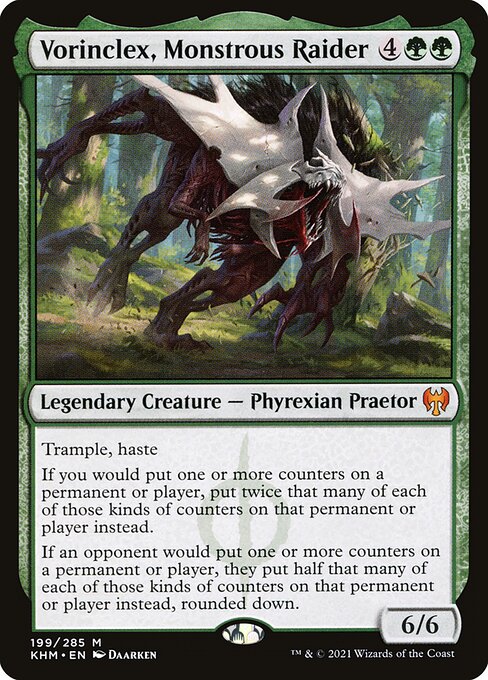
Vorinclex, Monstrous Raider
Doubles counters added to your permanents and halves counters removed from them
A single Vorinclex trigger turns every proliferate, every counter-adding spell, and every ramp piece with counters on it into double value, which makes it one of the strongest payoffs in the deck if your budget allows it.

The Ozolith
Saves counters from creatures that leave the battlefield
Protects your investment in a big creature against removal or a board wipe by moving its counters onto The Ozolith instead of losing them outright.
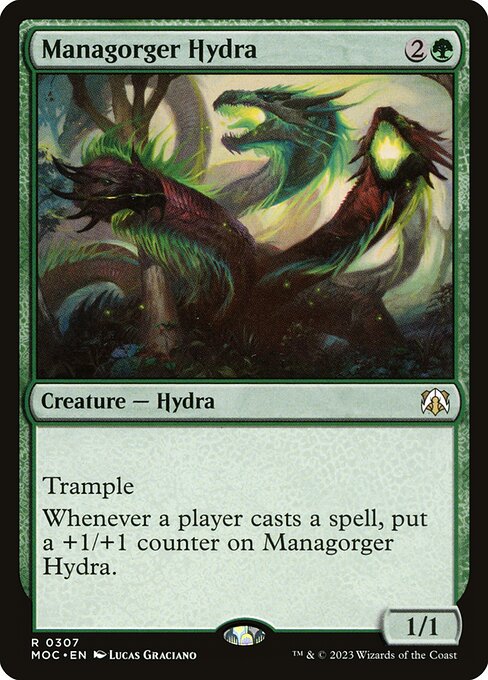
Managorger Hydra
Grows a counter every time any player casts a spell
Grows even on opponents' turns, which makes it one of the fastest-growing threats in the deck without needing any support at all.

Herald of Secret Streams
Gives your creatures unblockable
Turns a wide, counter-heavy board into an unstoppable attack, since a grown creature that cannot be blocked is very difficult for any table to answer in combat.
Round out the package with Forgotten Ancient to spread counters across the board, Evolution Sage to proliferate off landfall, Deepglow Skate as a one-time counter doubler for your whole board, Incubation Druid as ramp that gets better every proliferate, and Walking Ballista as a flexible counters payoff that doubles as removal.
Best poison and infect upgrades
This lane wants a small number of evasive toxic or infect threats backed by heavy proliferate, since ten poison counters end the game regardless of life total. Glistener Elf and Blighted Agent are cheap, unblockable or nearly unblockable infect threats. Bilious Skulldweller and Bloated Contaminator add toxic to bigger bodies, and Skrelv's Hive and Venerated Rotpriest spread toxic across the board.
Prologue to Phyresis and Infectious Inquiry add poison counters directly without needing combat damage at all, and Tainted Strike turns any creature into a one-time poison threat. Ichor Rats and Inkmoth Nexus add redundancy to the plan, and Phyresis Outbreak can give your whole team toxic at once. Contagion Clasp and Contagion Engine proliferate on their own, closing games faster than waiting on Atraxa's end step alone.
Best superfriends upgrades
This lane needs blockers, board wipes, ramp, and protection just as much as it needs planeswalkers, since a wide-open board with no defenses gets planeswalkers killed before they matter. Oath of Teferi lets your planeswalkers use loyalty abilities more than once a turn, which stacks well with proliferate ticking up their loyalty at the same time. Ichormoon Gauntlet, Deepglow Skate, and Evolution Sage all add extra loyalty on top of what Atraxa already provides.
Inexorable Tide and Flux Channeler proliferate every time you cast a noncreature spell, which fits a spell-heavy superfriends shell naturally. Teferi's Talent draws cards off your planeswalkers directly. Doubling Season is the premium tier here, doubling both loyalty on planeswalkers you play and counters added by proliferate at once. Tekuthal, Inquiry Dominus is a cheaper alternate commander-style payoff worth checking if you want a lower-cost version of a counter doubler. Resourceful Defense and Together Forever both help protect planeswalkers directly, and Pir, Imaginative Rascal is a budget-friendly counter payoff worth including if your list leans heavily on planeswalkers and creature counters together.
Budget swaps
A budget swap should replace the job a card does, not just its name. Some of these are close functional matches, others only cover part of what the expensive card does, so treat the table as a starting point, not a guaranteed 1:1 replacement.
Budget swaps for expensive Atraxa staples
| Expensive card | Budget swap | Role | What you lose | When the swap is good |
|---|---|---|---|---|
| Doubling Season | Hardened Scales, Winding Constrictor, or Evolution Sage | Extra counters on placement | Doubling planeswalker tokens and non-counter effects | Your deck is mainly +1/+1 counters, not a mix of counters and planeswalkers |
| Vorinclex, Monstrous Raider | Tekuthal, Inquiry Dominus, Deepglow Skate, or Pir, Imaginative Rascal | Doubling and halving effects | The symmetrical downside on opponents, and some raw power | You want a cheaper counter doubler without a premium price tag |
| The Ozolith | Resourceful Defense or Together Forever | Wipe insurance for counters | The portable, standalone counter storage | You mainly need to protect planeswalkers or a few key creatures, not preserve counters generally |
| Inkmoth Nexus | Blighted Agent or Glistener Elf | A land slot infect threat | The land-slot flexibility, this takes a creature slot instead | You need more infect bodies and are not short on land-slot utility already |
| Teferi's Protection | Heroic Intervention, Unbreakable Formation, or Clever Concealment | Board protection | Protection against removal aimed at you, not just your board | Your colors match and you mainly need to survive a wipe or a bad combat |
| Cyclonic Rift | River's Rebuke, Austere Command, or Farewell | A one-sided reset | The one-sidedness, these hit your own board too | You need a flexible removal package more than a one-sided sweeper |
| Mana Drain or Fierce Guardianship | Counterspell, Arcane Denial, Negate, or Swan Song | Stopping a key spell | Free or nearly free mana cost | You mainly need reliable interaction, not a completely free answer |
Cards to cut
- Cards with counters but no payoff to make those counters matter.
- Poison cards mixed into a deck that is not actually built around poison.
- Planeswalkers in a deck that cannot protect them from combat or removal.
- Too many five-plus-mana engines competing for the same late-game turns.
- Cute proliferate cards that do not meaningfully affect the board.
- Expensive staples added without a clear plan for what they support.
- Weak mana rocks in a deck that already has real green ramp.
- Slow tapped lands once the rest of the mana base is tuned for speed.
- Win conditions that do not match whichever archetype you chose.
Bracket and Game Changer impact
Atraxa can be a casual value deck or a genuinely threatening build depending entirely on which lane you build and how far you push it. A slower +1/+1 counters or general proliferate deck plays like a strong casual or Bracket 3 list. Poison, fast mana, premium tutors, Doubling Season, Vorinclex, Monstrous Raider, Cyclonic Rift, Rhystic Study, Smothering Tithe, and The One Ring all push the deck's bracket pressure up quickly, and a compact poison finish is a real bracket signal on its own. Not every Atraxa deck is high power, but Atraxa has a reputation at most tables, so explain your build's actual plan and speed clearly before the game rather than leaning on that reputation either way. Read Commander Game Changers Explained for the full picture on how these cards shift table expectations.
Audit your Atraxa deck before buying more staples
Deckcipher can help you check your Atraxa deck's mana, ramp, draw, interaction, Game Changers, price drivers, and cards to review before you spend money on upgrades.
FAQ
Is Atraxa, Praetors' Voice still good in Commander?
Yes. Her body is already hard to attack into, and her end step proliferate rewards any deck built around counters, poison, or planeswalkers, which keeps her relevant across several different archetypes.
What is the best way to build Atraxa?
Pick one main lane, +1/+1 counters, poison, superfriends, or general proliferate value, and build the mana, draw, and protection around that specific plan instead of mixing every good counter card into one deck.
Is Atraxa better as +1/+1 counters, poison, or superfriends?
There is no single best lane, each rewards a different playstyle. Counters wants a wide creature board, poison wants a fast, focused finish, and superfriends wants a grindy value game. Pick the one that matches how you like to play.
How many lands should Atraxa run?
Most Atraxa decks run around 36 to 38 lands. Four colors need reliable fixing, so do not cut lands just to fit in more spells.
How much ramp does Atraxa need?
Plan for around 10 to 12 ramp and fixing pieces, prioritizing effects that fix colors over ones that only add generic mana, since four colors need fixing more than raw acceleration.
What are the best Atraxa budget upgrades?
Start with typal-free fixing lands, green ramp that fetches nonbasics, a cheap counter doubler like Hardened Scales or Winding Constrictor, and enough card draw to keep the deck running.
What expensive Atraxa staples have budget swaps?
Doubling Season, Vorinclex, The Ozolith, and Inkmoth Nexus all have role-based budget swaps, though none are exact one-to-one replacements. Check the budget swaps table above for specifics.
What cards should I cut from Atraxa?
Cut cards with counters but no payoff, poison cards in a non-poison build, planeswalkers you cannot protect, and any card that does not support the one archetype you chose.
Is poison Atraxa too strong for casual Commander?
It can be. Poison ends games in a way many casual tables have never seen and do not enjoy, so mention that plan clearly before the game the same way you would flag any other bracket-raising strategy.
What bracket is Atraxa, Praetors' Voice?
It depends entirely on the build. A slower counters or general proliferate deck plays like a strong casual or Bracket 3 list, while a poison-focused or fast mana and tutor-heavy build can push toward Bracket 4.
Conclusion
Atraxa rewards focus more than raw card power. Pick one lane, +1/+1 counters, poison, superfriends, or general proliferate value, and build the mana, draw, and protection around that specific plan. Atraxa's end step is the payoff for a deck that already knows what it is doing, not a replacement for actually having a plan. Choose your lane first, and the rest of the deck gets much easier to build.